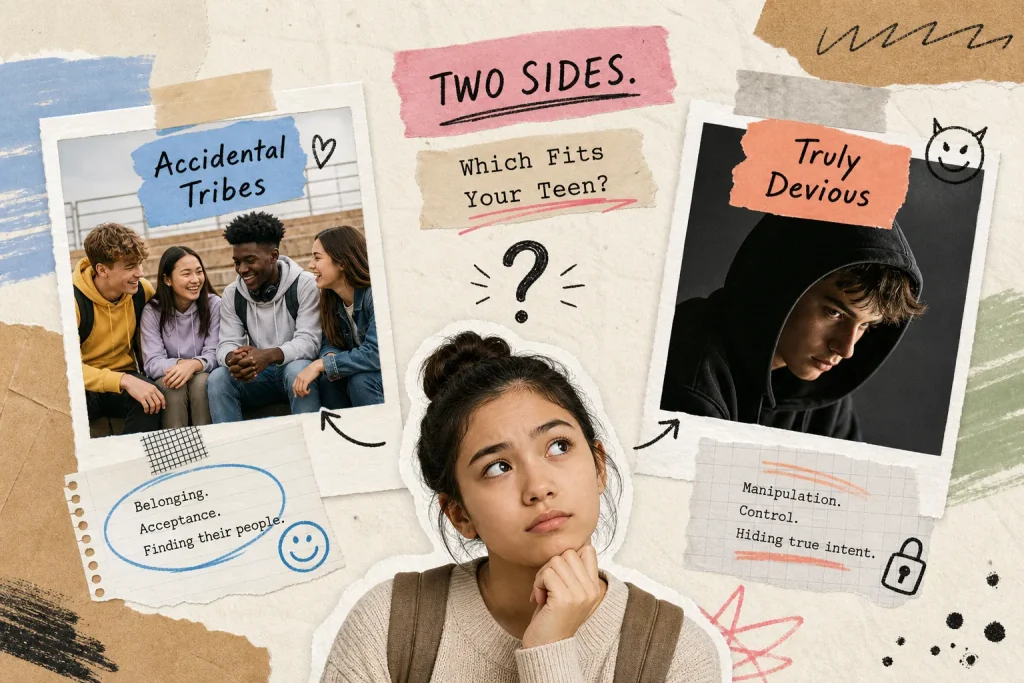
That’s exactly what this article is here to settle. Below is a clear, honest breakdown of Accidental Tribes by C.S. Pascoal (Prospera Books, 2026) and Truly Devious by Maureen Johnson (2018). By the time you reach the end, you’ll have a confident answer, not just a “both are great” shrug.
One thing to say up front: neither book loses this comparison. They’re good in very different ways, for different readers, at different points in a teen’s reading life. The goal here is to match the right book to the right kid, not to crown a winner.
What each book is actually about
Back-cover copy is a marketing tool, useful, but not always honest about what the reading experience actually feels like. Publishers write to sell. So here’s a cleaner look at what’s actually inside each book.
Accidental Tribes follows eight teenagers at an underfunded public school near Times Square who get pulled into a 30-day intervention called Experiment 359. Nobody volunteered. Everyone has something to hide. As the group is forced to exist together in an isolated classroom called Solitaria, they start pulling on threads that lead to a mysterious death, missing school funds, and institutional lies that were never supposed to surface. The story is told through eight rotating perspectives, and an illustrated format keeps it visually engaging throughout. It launches September 22, 2026.
Truly Devious follows Stevie Bell, a teen obsessed with a famous unsolved kidnapping from the 1930s, who enrolls at the elite Ellingham Academy in Vermont partly because it’s the original setting of the cold case. When strange events at the school begin mirroring the old crime, past and present start to blur. It’s atmospheric and cerebral, leaning into Gothic boarding-school tension. It’s also the first book in a series, which means several threads are deliberately left unresolved by the final page.
How does Accidental Tribes compare to Truly Devious for teen readers? Start with themes.
Both books are mysteries. But they’re asking very different questions, and theme alignment matters more than most people realize when you’re choosing a book for a specific kid.
Accidental Tribes is rooted in the world teens are actually living in right now. AI-generated harassment, viral humiliation, anonymous accounts, hacked systems, and the particular loneliness that social media creates while pretending to solve it, none of these are backdrop details. They’re central to the plot. For a teen who has experienced a group chat blowup, watched a classmate get publicly humiliated online, or wondered who’s actually controlling the information at their school, this book will hit somewhere recognizable and real.
Truly Devious operates in a different register entirely. Its core obsession is a cold case from the 1930s, which means the tension is more intellectual than visceral. Teens who love puzzle-solving, locked-room logic, and the slow unraveling of a decades-old crime will find a lot to work with here. The contemporary stakes exist, but they’re secondary to the historical thread. For readers who want an escape from the digital world rather than a mirror of it, that’s a genuine selling point.
Content warnings and age-appropriateness: what adults need to know
Both books are shelved as Young Adult, but YA covers a wide maturity range. A 13-year-old and a 17-year-old are both technically in the YA audience, and the gap between them is enormous. Here’s what you actually need to know before handing either book to a specific teen.
Accidental Tribes is recommended for readers ages 13 and up by The Children’s Book Review, which describes it as “fast-paced and compelling, perfect for teens who want fiction grounded in the realities of the twenty-first century.” The book deals seriously with cyberbullying, institutional corruption, and a mysterious death, but handles those themes with care. There is no graphic violence, sexual content, or explicit language. The illustrated format and ensemble structure keep the tone engaging rather than heavy, which makes it a strong fit for middle school classrooms as well as high school readers.
Truly Devious carries more mature content throughout. According to Common Sense Media, the book contains regular strong profanity (appearing multiple times throughout), alcohol and drug use including heavy drinking by one student, champagne served to new students, and references to pot smoking and vaping. Romantic content includes same-sex and opposite-sex kissing and a couple described as “rolling around on the floor.” Violence includes a kidnapping, multiple deaths across the 1930s storyline, and present-day danger. Most educator and library sources recommend Truly Devious for ages 14 and up, with Bookroo placing the series in the 14 to 18 range. It’s a well-crafted book, but it’s not the right first choice for younger middle schoolers or for classrooms where content sensitivity is a concern.
Pacing, tone, and whether a teen will actually finish it
Knowing what a book is about is one thing. Knowing whether a specific teen will get past chapter three is a completely different question.
Accidental Tribes is built for the modern teen attention span, without dumbing anything down. Short chapters, rotating perspectives across eight characters, and illustrated pages keep the reading experience moving. Each chapter generates enough pull to push into the next one. For reluctant readers, or for teens who insist they “don’t like reading,” this structure removes a lot of the friction. The Teen Advance Reader Council that reviewed the book ahead of its 2026 launch confirmed what the format suggests: it reads fast, and it holds attention.
Truly Devious moves more deliberately. It rewards patience and suits readers who enjoy sitting with atmosphere and letting a mystery build. Goodreads reviewers describe the pacing as a slow burn, with the book gaining significant momentum around the halfway point. Its Goodreads average sits at 3.88 out of 5 across more than 150,000 ratings, which reflects a genuinely engaged fanbase alongside readers who found the pacing challenging. Teens who already love the mystery genre tend to rate it much more enthusiastically than those coming to mystery fiction for the first time.
There’s also the question of protagonist structure. Stevie Bell is a compelling solo lead: specific, quirky, driven by a singular obsession. Readers who like getting deep inside one character’s head will appreciate that intimacy. Accidental Tribes takes the opposite approach. Eight characters means eight entry points into the story, so readers who don’t connect immediately with one character almost always find their person somewhere in the ensemble. That also makes it a stronger group-read experience, since different readers in a class or book club naturally gravitate toward different characters and bring those perspectives into the discussion.
Book-club and classroom fit: which book does more work for educators
For teachers and librarians, the question is never just “is this a good book?” The more practical question is: what does this book let us do in a room full of teenagers?
Accidental Tribes was designed with that question in mind. Classroom and library resources are available specifically to support discussions around AI literacy, digital citizenship, identity, belonging, and ethical decision-making. These themes align directly with what middle and high school educators are already expected to address, and they connect to conversations that are genuinely urgent in American schools in 2026. The book was endorsed by educators and stress-tested by a Teen Advance Reader Council before publication, which means the discussion material has already been tried with actual teen readers. Classroom utility wasn’t added as an afterthought.
Truly Devious does support rich discussion around historical injustice, obsession, and institutional trust. A publisher-created Book Club Companion Guide exists, with questions covering themes like friendship, identity, and mental health. The practical complication for classroom use is the unresolved series structure: the central mystery doesn’t close in a single volume, which can be frustrating for a classroom unit that needs narrative closure. The conversations most urgent in American middle and high schools right now involve AI, social media pressure, and who controls information. Accidental Tribes was written with that moment as its primary concern.
So which book is right for your teen? Here’s how to choose.
Both books are worth your teen’s time. The right choice depends on who that teen is.
Choose Truly Devious if your teen is 15 or older, already reads regularly, loves atmospheric mysteries, and has patience for a layered, multi-book story. This is the right pick for teens who love historical puzzles and want an escape from the digital world rather than a reflection of it. Fans of Agatha Christie’s plotting style or Gothic boarding-school settings will feel completely at home here.
Choose Accidental Tribes if your teen is between 13 and 18, relates to feeling misunderstood or out of place, or is navigating real social pressure connected to technology and online life. This is also the right first choice for reluctant readers, classroom groups, and any context where the book needs to generate conversation rather than just entertainment.Free first chapters are available online if your teen wants to sample the story before committing, and the book launches September 22, 2026.
The bottom line: Accidental Tribes vs. Truly Devious for teen
readers
A good YA mystery does two things at once: it keeps you turning pages, and it leaves you thinking about something real long after you’ve closed the cover. Both Accidental Tribes and Truly Devious do that. They just do it for different readers, in different seasons of their reading lives.
When you’re comparing Accidental Tribes vs. Truly Devious for teen readers, the question isn’t really which book is better. It’s which book is right for the specific teen standing in front of you right now. Use the breakdown above to make that call with confidence. And if you’re still on the fence, the free first chapters of Accidental Tribes are a low-stakes way to find out.