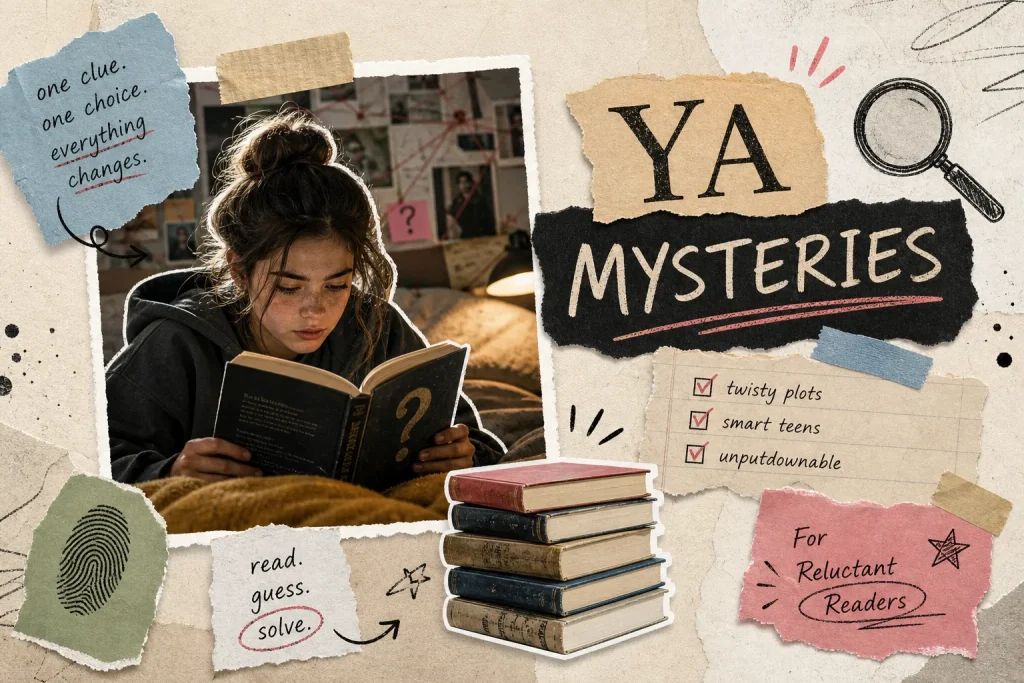
Here’s what most people in that moment don’t realize: the problem usually isn’t reading. The problem is format. A teen who says they hate books often means they hate the experience of staring at an unbroken wall of prose with no visual anchor, no sense of pacing, no immediate reward for turning the page. Illustrated YA mystery books solve exactly that problem. They sit at an almost unfair intersection of suspense and visual storytelling, and many educators report that these books have quietly converted self-described non-readers into kids who finish a story in a single sitting.
This article will walk you through what makes illustrated mysteries different from standard YA fiction, how to tell a graphic novel apart from an illustrated edition, which specific titles are worth putting in a teen’s hands right now, and how to match the right book to the right reader. We’ll also look at one new release from Prospera Books that’s raising the bar for what this format can do.
Why the illustrated format changes everything for reluctant readers
What artwork does that prose alone often can’t
Reading a novel requires a particular kind of mental heavy lifting: you have to decode text, construct characters in your imagination, and track tone, all at once. For a reluctant or struggling reader, that load is often what makes reading feel exhausting rather than enjoyable. Illustrations change the equation. When a character’s face appears on the page, scared, defiant, devastated, the reader doesn’t have to build that image from scratch. The art carries it, which frees up mental energy to simply follow the story.
Research from organizations like the International Dyslexia Association, along with reports from school library associations, has documented this effect consistently. Illustrated and graphic-format books improve comprehension and reading confidence for struggling readers, including those with dyslexia, by making the narrative feel more manageable. The visual cues don’t simplify the story; they scaffold it. That’s a meaningful distinction, especially for teens who’ve already decided reading isn’t for them.
How visuals drive pacing in mystery and suspense
Pacing is the engine of any good mystery. The slow reveal, the held breath, the moment a clue finally clicks, each one needs to land at exactly the right speed. In illustrated mysteries, the artist controls that speed in ways that pure prose can’t match. A single panel, a close-up on a hand slipping something into a pocket, can create dread in under a second. A full-page spread of an empty hallway says something in negative space that might take a paragraph to describe in text.
Artists use color, shadow, panel size, and framing to accelerate or hold tension deliberately. This is why the mystery genre often translates particularly well into illustrated formats. The visual language of suspense, the tight frame, the low angle, the figure half-hidden at the edge of the panel, maps almost perfectly onto how a good mystery novel builds atmosphere. For a teen reader who needs to feel momentum on the page, this matters enormously.
Graphic novel vs. illustrated edition: what’s the actual difference
How graphic novels tell their story
A graphic novel tells its story through sequential art panels, where the images and the text are inseparable. Remove the artwork from a graphic novel and you don’t have a readable story anymore; you have fragments. In a mystery context, this means a reader might follow a detective’s deduction not through a paragraph of internal monologue but through a sequence of panels: a face, a shadow, an object, a reaction. The narrative happens in the space between images as much as in the words themselves.
For deeply reluctant readers, graphic novels are often the strongest entry point because they’re typically faster reads with built-in visual rewards on every page. Series like the Enola Holmes graphic adaptations, which bring Nancy Springer’s detective fiction to sequential art, or Northranger by Rey Terciero and Bre Indigo (2023) show how well this format handles mystery-adjacent suspense. Northranger in particular, with its Gothic atmosphere and sharp character chemistry, works well for readers around 13 and up who are completely new to the genre. (That age guidance reflects the book’s content and tone; always check the publisher’s full content notes for your specific reader.)
What illustrated editions offer instead
Illustrated editions are prose novels with artwork woven in at key moments. The text does the primary narrative work; the illustrations appear to anchor character, atmosphere, or a charged scene. Think of them as a hybrid: the structure and depth of a novel with visual checkpoints that keep a hesitant reader grounded. For a teen who’s almost but not quite ready to commit to 300 pages of uninterrupted prose, this format hits a genuinely useful middle ground.
The Swifts: A Dictionary of Scoundrels by Beth Lincoln, illustrated by Claire Powell, is a useful example here. It won the Barnes & Noble Kid Lit Book Award and tends to work well for younger middle-grade and early YA readers, roughly the 11-to-14 range, with its lighter mystery tone and warmly quirky illustrations. It’s a strong first step before moving toward heavier or more visually complex YA titles. The key distinction to remember is this: in a graphic novel, the art tells the story; in an illustrated edition, the art enriches it.
Illustrated YA mystery titles worth putting in your teen’s hands
For fans of ensemble casts and high-stakes plots
Northranger by Rey Terciero and Bre Indigo (2023, full graphic novel) is a Gothic-influenced illustrated mystery with genuine character chemistry and a suspense that builds slowly and then doesn’t let go. It tends to work best for readers around 13 and up, particularly teens who are familiar with the ensemble mystery format from popular YA fiction but haven’t yet tried the graphic novel version of that experience. Worth knowing before you hand it to a younger teen: the book carries content notes around homophobia, mentions of death, grief, and some depictions of violence. A quick scan of the full content warning list before passing it to a 13-year-old on the more sensitive end is genuinely worthwhile.
For the reader who wants classic detective energy
The Enola Holmes graphic novel series, adapted from Nancy Springer’s novels, keeps all the procedural detective energy of the original books while adding real visual personality to Enola’s narration and deduction sequences. These work well for readers around 12 and up, carry mild content notes around peril and period-accurate themes, and are commonly found in school and public library collections across the United States. For older teens who want something darker and more contemporary, This Place Kills Me by Mariko Tamaki, illustrated by Nicole Goux (2025), is a strong choice. It has a strong presence in book community spaces and is better suited to readers 14 and up given its heavier thematic content.
For the illustrated edition reader who’s not ready for pure graphic novels
The Swifts: A Dictionary of Scoundrels by Beth Lincoln is the illustrated edition worth keeping in your back pocket for younger or more hesitant readers. Its mystery tone is lighter, its humor is genuinely charming, and the illustrated format bridges the gap between a chapter book and a YA novel in a way that doesn’t feel condescending. For a reader aged 11 to 14 who’s been burned by books that felt too long or too dense, this is a confidence-building first step.
Accidental Tribes: what the illustrated mystery format looks like done right
Eight characters, one forgotten classroom, zero easy answers
Accidental Tribes by C.S. Pascoal, published by Prospera Books and launching September 22, 2026, is the illustrated YA mystery that this entire conversation has been building toward. Eight defiant teenagers are sent to a forgotten classroom called Solitaria. What they find there isn’t a punishment: it’s a buried secret involving an unsolved death, stolen funds, and institutional lies that someone worked very hard to keep hidden. The story is fast, the characters are distinct, and the mystery is genuinely complicated.
The illustrated format in Accidental Tribes isn’t decorative. With eight teen characters to track across an ensemble cast, illustrations do real narrative work: they make each character immediately recognizable and emotionally specific in a way that would take significantly more pages of prose to achieve. For a hesitant reader, this matters because they spend less time getting lost and more time getting pulled forward. That’s exactly the experience this format, at its best, should create.
Why the artwork earns its place in this story
According to the publisher, the themes in Accidental Tribes are drawn directly from the world teens are actually navigating: AI misuse, viral humiliation, anonymous accounts, and social media addiction. The illustrations carry the emotional specificity of those experiences in ways that deepen the mystery without slowing it down. A character’s micro-expression when a screen lights up tells you something the prose is still building toward. The visual weight of a message sent anonymously lands differently on the page than a sentence describing it would, and that gap is exactly where illustrated storytelling earns its place.
Early readers and educator reviewers have responded warmly to the book ahead of its September 22 launch, with endorsements noted from literary publications including Midwest Book Review and The Children’s Book Review. Pre-order is available now through Prospera Books, and the publisher plans to make a free first-chapter preview accessible online for readers who want to get a feel for the story before committing. Classroom and library resources are also planned for educators who want to use the book in a digital citizenship or AI literacy unit, check the Prospera Books site closer to launch for availability.
How to pick the right illustrated mystery for your teen reader
Age range, content notes, and format fit
Younger teens, roughly 11 to 13, generally do well starting with full graphic novels or lighter illustrated editions that use simpler visual language and a more accessible page layout. Older teens, 14 to 18, can handle denser illustrated editions, darker themes, and more complex panel structures. This isn’t a strict rule, but it’s a useful starting framework when you’re standing in a bookstore and not sure where to begin.
Content warnings deserve real attention in this genre. Violence, substance use, and self-harm appear in some of the most popular illustrated mystery titles, and a book that’s right for a confident 16-year-old reader might not be right for a sensitive 13-year-old. Publisher pages and trusted review sources like Midwest Book Review or school library guides will usually list specific warnings. The goal is to find the book this particular teen will actually pick up and finish, not the one that looks most impressive on a shelf.
Where to buy, borrow, or pre-order
Barnes & Noble and Bookshop.org commonly stock illustrated YA mystery titles in both print and digital formats, though availability varies by title and platform. Local public libraries are worth checking first, since many carry graphic novels and illustrated editions and offer digital borrowing through Libby at no cost. School and public libraries across the United States, from Madison Public Library to San José Public Library, have been actively building illustrated mystery collections in their YA sections, so catalog availability is often better than people assume.
For Accidental Tribes specifically, pre-order is available through Prospera Books before the September 22, 2026 launch date. The free first-chapter preview is a genuinely low-commitment way for a skeptical teen, or a skeptical adult buying for one, to get a feel for the story before committing to the full book.
The right book changes things
That teenager standing in front of a bookshelf, unconvinced, isn’t broken. They just haven’t found the book that feels like it was made for them. Illustrated mysteries have a particular talent for being that book, because they meet resistant readers where they are and then quietly refuse to let them go.
When you’re choosing, keep the basics in mind: know the format, match the age and content fit, and don’t underestimate how far a great illustration on page one can travel. A single panel can make a teen flip to page two. Page two leads to page three. That’s where reading habits are actually built, not in a lecture about the importance of books, but in a story that earns the next page entirely on its own terms.
If you’re looking for the illustrated mystery that does all of this while taking seriously the world teens are actually living in, Accidental Tribes by C.S. Pascoal is worth pre-ordering before September 22. It’s the kind of book that doesn’t just entertain a teen who’s given up on reading. It proves to them that the effort was worth it.