That silence bothered me for a long time. The rubric was solid. The article was credible. The harm was real. But something was missing, and it took me a while to name it: the students had no one to care about. They processed the lesson as information. They never felt the stakes. That gap, between completing an assignment and genuinely grappling with an ethical problem, is exactly what this article addresses.
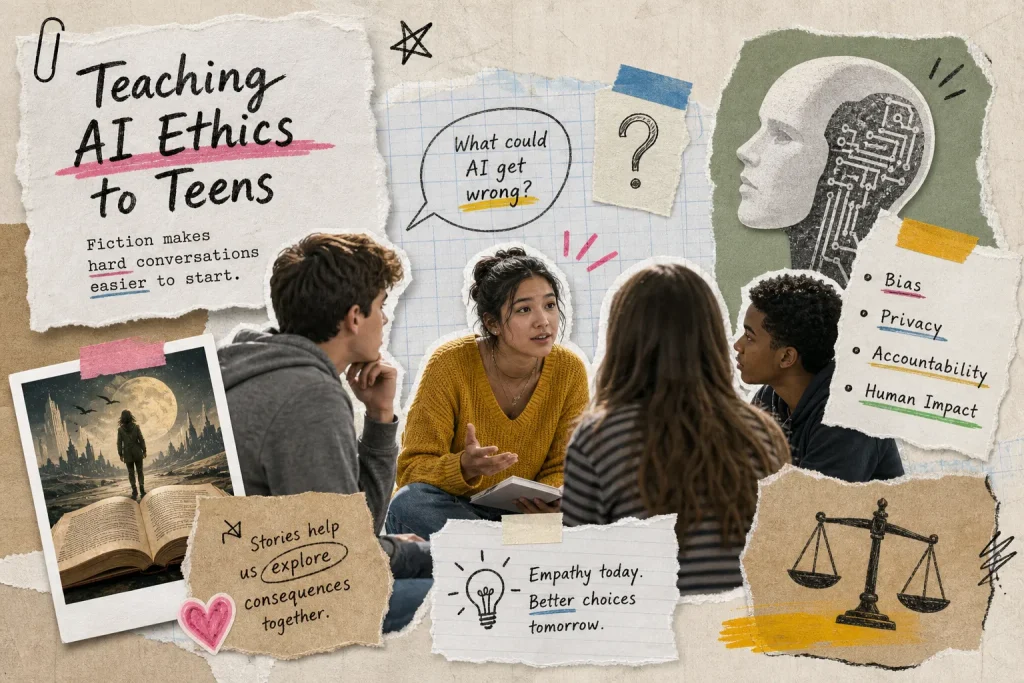
Teaching AI ethics to teens is one of the most important things a classroom teacher can do right now, and one of the hardest to do well. When abstract concepts like data misuse or AI-generated harassment live inside a story, teens don’t just process them intellectually. They feel them. They argue about them. They take sides before the discussion even starts. C.S. Pascoal’s illustrated YA mystery Accidental Tribes (Prospera Books, 2026) is built around AI ethics themes that map directly onto classroom learning objectives, and this article uses it as a through-line while offering a practical framework any teacher can adapt: grade-level objectives, ready-to-run activities, and an assessment approach grounded in real research.
Why AI ethics lessons often fall flat in the classroom
The abstraction problem is real, and it’s worth naming before we try to fix it. Concepts like algorithmic bias, surveillance capitalism, and data misuse don’t feel concrete to a 14-year-old who has never thought about how a social media feed is curated. When a lesson opens with “here is a definition of algorithmic harm,” students comply. They take the notes. They don’t engage. The concept floats above their experience and never lands anywhere that matters.
The research on teen ethical reasoning supports what most teachers already know from the silence in their own classrooms. The Imagine a More Ethical AI project found that 84% of teen participants said stories helped them make sense of AI ethics issues in ways that direct instruction alone did not. The DAILy workshop study showed statistically significant improvement in AI concept understanding after hands-on, story-adjacent activities. A systematic review of K-12 AI ethics studies found that constructivist approaches, especially placing students in the role of someone affected by an AI decision, were associated with stronger learning outcomes for this age group than lecture-based instruction alone. This isn’t an argument against rigor. It’s an argument for the right entry point.
What storytelling does that a lecture can’t
Before a student can reason about whether an algorithm is fair, they need to care about someone the algorithm harms. Fiction makes that caring more immediate. When a character is humiliated by AI-generated content, a student’s instinct to defend that character tends to activate before any rubric asks them to. That instinct is the raw material that good classroom discussion sharpens into ethical reasoning. The emotion comes first, and the analysis follows.
There’s also what researchers call the “designer’s perspective” effect. Role-based design studies suggest that placing students in the role of AI designers or stakeholders, even fictional ones, produces better understanding of ethical challenges than passive instruction. In a story, a student reader naturally occupies multiple perspectives: the character being harmed, the developer who built the system, the institution that deployed it. That multiplicity is exactly what ethical analysis requires. A lecture gives students one perspective. A well-chosen novel gives them several, and it does it without requiring the teacher to manufacture empathy from scratch.
Teaching AI ethics to teens through fiction: why the medium
matters
AI literacy for high school and middle school students develops differently than it does for adults. Teens process moral scenarios more vividly when they are embedded in social situations involving peers, identity, and consequence, the exact territory that good YA fiction occupies. A character facing online humiliation from AI-generated content isn’t an abstraction. It’s a situation teens recognize, fear, and want to talk about. That recognition is the on-ramp that moves students from passive compliance to genuine ethical reasoning.
This is also why age-appropriate AI ethics lessons need to be designed differently than adult professional development on the same topics. The goal isn’t fluency in policy language. It’s the capacity to ask the right questions, who built this, who benefits, who gets hurt, and what should we do about it, in a context that feels real enough to argue about.
Accidental Tribes as a classroom AI ethics case study
Accidental Tribes (Prospera Books / C.S. Pascoal, September 2026) follows eight teenagers placed in a forgotten classroom called Solitaria, where they begin uncovering institutional deception, an unsolved death, and the digital manipulation that made it all possible. According to the publisher, the book’s central conflicts land directly inside AI ethics territory: AI-generated content weaponized for social humiliation, anonymous accounts used to manipulate peer dynamics, hacked systems, viral misinformation, and the data trails students leave without realizing it. These aren’t metaphors. They are the actual subject matter of an AI literacy unit, rendered in character and plot.
The illustrated format carries a specific pedagogical advantage worth noting. Visual panels showing a character’s humiliation spreading online, or a data log being accessed without consent, create a concrete image that a definition never could. For reluctant readers and visual learners, the combination of image and text closes the gap between concept and comprehension. Studies examining graphic novel formats in secondary classrooms suggest that visual scaffolding helps struggling readers infer character motivation and moral consequence, the exact skills ethical reasoning requires. Teachers don’t have to ask students to imagine what algorithmic harm looks like. The book shows them, and from that shared image, discussion becomes far more specific and productive.
The ensemble cast of eight distinct characters also functions as an ethical reasoning engine. Drawn from different social positions and identity backgrounds, the cast may help students in a wide range of classroom demographics find a character whose situation resonates. When the discussion asks “who is responsible for what happened to this character,” students arrive already anchored in a perspective. The teacher’s job is to widen the frame, not create one from scratch.
Grade-level learning objectives for teaching AI ethics to teens
At the middle school level (grades 6, 8), students are working toward recognition and basic analysis. By the end of a fiction-based AI ethics unit, students should be able to:
- Identify when AI is being used in the story and in their own lives
- Name a privacy or fairness concern in a specific scene
- Explain how bias can enter a system through data or design choices
- Articulate how an AI decision affected one character differently than another
These objectives align with CSTA grade-band standard 2-IC-21, which asks students to discuss issues of bias and accessibility in existing technologies, and with Code.org’s middle school AI literacy course goals. (Note: teachers should verify the exact standard number against the current CSTA K, 12 Computer Science Standards document, as numbering has been updated across recent editions.)
High school instruction (grades 9, 12) should move students from recognition to evaluation and advocacy. By the end of the unit, students should be able to:
- Assess an AI system using criteria like fairness, transparency, and accountability
- Analyze who benefits and who is harmed in a specific scenario from the text
- Debate a dilemma, such as whether the institution in the story bears responsibility for the algorithmic harm that occurred
- Draft a position on responsible AI use that they can defend
These outcomes align with ISTE’s empowered learner framework and with CSTA’s high school standards addressing bias, harms, and privacy in AI and training data. State-level guidance in California, Virginia, and Washington also maps onto these objectives, teachers should consult their state’s current AI literacy guidance documents to verify specific alignment.
Classroom activities for teaching AI ethics to teens: from reading to reasoning
The bias detection activity is a direct starting point. Take a scene in which AI-generated content is used to harm or manipulate a character, then have students work in pairs to answer three questions: what data made this possible, who built or authorized the system, and who did not anticipate the harm? This mirrors the bias-detection challenge structure from MIT’s AI + Ethics curriculum, where students compare outcomes across inputs and propose fixes. The fiction grounds each step so students aren’t reasoning in a vacuum. Budget approximately 35, 40 minutes for the activity plus a 10-minute whole-class debrief.
Accountability role-play (grades 9, 12)
The accountability role-play is well-suited to the 9, 12 objectives. Assign students roles from the novel: the affected characters, the institution’s administrators, the developer of the system, and a student journalist. Run a 20-minute structured debate in which each group must defend a position on who bears responsibility for the harm. Then open 15 minutes for the class to draft a shared set of accountability principles. This format mirrors structured stakeholder workshop activities documented in the research literature and builds directly toward the high school objective of evaluating stakeholder trade-offs.
Data privacy warm-up (15, 20 minutes)
For a shorter warm-up, the data privacy boundary exercise works well before a longer discussion. Ask students to list the data each character in the story shared, knowingly or not, and what consequences followed. Then apply the same lens to their own digital habits: what do they share, with whom, and what could be done with it? Common Sense Education’s grab-and-go AI literacy lessons use a similar structure and can supplement this exercise with additional prompts for classes that want to go further.
Assessing ethical reasoning without flattening the conversation
The AAC&U Ethical Reasoning Value Rubric is a practical starting point for educators who want a validated assessment tool. Its five criteria, identifying the ethical issue, applying ethical frameworks, considering multiple perspectives, addressing the complexity of the dilemma, and making a reasoned judgment, map onto both the novel’s themes and the activities above. Presented as a list, the criteria are easier to parse than when embedded in a single run-on sentence:
- Identifying the ethical issue
- Applying ethical perspectives
- Considering different perspectives
- Addressing the complexity of the dilemma
- Making a reasoned judgment
The 4-point scale allows for differentiation across grade levels without becoming punitive. Pair the rubric with a reflection prompt: “What did the story make you see that a news article about the same topic wouldn’t have?” That prompt is where students often surprise you.
Teachers who need to justify their unit to administrators or curriculum committees can point to CSTA’s grade 6, 8 standards addressing the impact of computing on people from varied perspectives; Code.org’s CSTA-aligned AI materials; ISTE’s empowered learner and digital citizen standards; and state-level AI literacy guidance in California, Virginia, and Washington. Classroom and library resources for Accidental Tribes, including teacher discussion guides designed to support standards-adjacent units, are planned through Prospera Books. Teachers don’t have to build everything from scratch.
The story was always the point
I think about that silent classroom a lot. The students weren’t disengaged because they didn’t care about algorithmic bias. They were disengaged because they had no reason to. The rubric gave them a framework, but it didn’t give them a person to fight for.
Teaching AI ethics to teens isn’t about finding the right worksheet. It’s about finding the right story, one where students care about a character before they’re asked to evaluate a system. When that story does its job, ethical reasoning stops feeling like an assignment. Students push back on each other. They ask follow-up questions. They leave the room still talking about it. AI and digital citizenship for teens become something they want to figure out, not something they’re required to document.
Accidental Tribes was built for that moment. Free first chapters and classroom resources are expected to be available ahead of the September 22, 2026 launch, check Prospera Books for the latest on availability. If you’re planning a fall unit on digital citizenship, AI literacy, or ethical reasoning, that’s where to start. Your students are ready for this conversation. They just need the right story to open it.