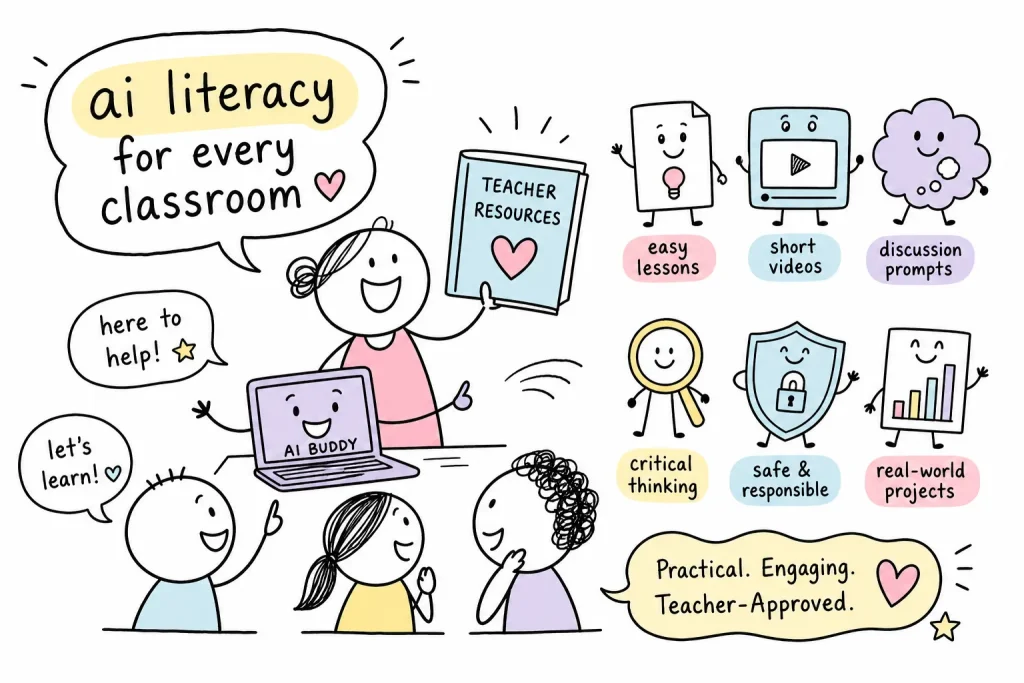
The problem isn’t you. The problem is that AI ethics is abstract, and abstract ideas need emotional traction before they need definitions. Students can memorize what machine learning means and still have no framework for processing what it feels like when a classmate’s face appears in a fake photo circulating the school hallway. Knowing about AI is not the same as thinking critically about it.
This article maps the AI literacy classroom resources actually worth your time in 2026, organized by format and grade band, with honest notes on what each one does well and what it doesn’t. And then it makes a case for something educators are quietly discovering: a well-chosen piece of fiction can meaningfully deepen AI ethics fluency when paired with structured lessons, because story does something definitions can’t. By the end, you’ll have a concrete framework for a short unit your students will actually engage with.
Why most AI literacy lessons don’t stick with students
The gap between knowing about AI and thinking critically about it is wider than most curricula acknowledge. Students who can label the parts of a machine learning diagram may still have no mental model for what it means when an institution hides behind an algorithm to avoid accountability. Critical thinking about AI isn’t a vocabulary exercise; it’s a practice that requires students to feel the stakes before they analyze the system. Most free AI literacy curriculum teaches the first thing and quietly skips the second.
Classroom experience and cognitive science research alike suggest that narrative engagement activates the kind of empathetic reasoning that transfers to real-world ethical judgment. Adolescents process abstract ethical questions more readily when those questions are attached to specific characters in specific situations. When students care what happens to someone in a story, they’re primed to ask harder questions: who designed this system, who benefits, and who gets hurt? That’s the emotional entry point that free downloadable AI lesson plans rarely build in, because it’s harder to put in a slide deck than a definition.
Free AI literacy classroom resources worth bookmarking for grades 6, 12
Lesson plans and slide decks that cover ethics, bias, and safety
Several well-maintained repositories offer genuinely usable free materials. Day of AI from MIT RAISE provides a full K, 12 curriculum with teacher slides, educator guides, and student pages, including modules on bias and ethics that work well for grades 6, 10. Registration is required, but the materials are completely free. Common Sense Education’s AI literacy collection for grades 6, 12 includes printable handouts and a downloadable slide deck and explicitly covers social and ethical impacts of AI, which makes it one of the cleaner options for teachers who need something fast.
For high school specifically, the AI4K12 “Explore AI Ethics” directory curates resources tagged by topic, including bias, privacy, and accountability. The Evolve AI Institute offers free grade-specific lessons with objectives, materials, activities, and rubrics already built in, a meaningful time-saver for teachers building a unit from scratch rather than retrofitting someone else’s curriculum. These aren’t perfect resources, but they’re honest about what they’re for and they’re genuinely usable.
Where to find standards-aligned materials and assessment tools
If standards alignment matters for your school or district, the ISTE AI Explorations and Capstone Projects materials connect explicitly to ISTE for Educators standards and, in some versions, to state standards. The AI Literacy Worksheets site organizes materials by grade band, K, 2, 3, 5, 6, 8, and 9, 12, and includes answer keys and teacher guides, which makes it practical for teachers who need something ready to hand to students without heavy adaptation.
For ethics-specific units, the NSF-funded ICICLE curriculum for high schoolers structures entire modules around fairness, privacy, transparency, and accountability, with built-in assessment framing that’s Common Core-adjacent in its argument and evidence focus. ISTE standards for students are the most commonly cited framework for AI literacy in middle and high school curricula in 2026, with state-level guidance running a close second. Common Core appears mostly as a supporting alignment for reading and writing tasks, not as the primary AI literacy structure.
Classroom-safe generative AI tools and interactive activities
Before assigning any generative AI activity, educators need tools with admin controls, privacy protections, and content filtering. SchoolAI is built specifically for supervised classroom use, with flagging and scope controls built into the product rather than bolted on as an afterthought. Khanmigo works well as a student-facing tutoring tool with meaningful guardrails. Google Gemini for Education and Adobe Express for Education are both described by their vendors as education-focused, with no student data used to train their underlying models; many districts and ed-tech organizations recommend this category of managed tools for classroom AI use.
Interactive activities that consistently work include critiquing AI output for accuracy and bias, structured supervised chat with school-managed tools, and creative multimedia projects in Canva or Adobe Express. The pattern in all of these is that the teacher remains in control of the experience. Open-ended consumer chatbots without supervision architecture are not what major education organizations recommend for classroom use, and that distinction matters more than which specific tool you choose.
How fiction teaches what free slide decks can’t
When a real student in your class has experienced a deepfake or had an anonymous account made about them, a lesson on algorithmic bias can feel uncomfortably close to an exposure. Fiction creates protective distance. Students can interrogate a character’s experience of digital humiliation or AI-enabled harassment without anyone in the room being the subject. That distance isn’t avoidance; it’s what makes the conversation go deeper. Students can be honest about what they think without feeling personally accused or exposed.
The best AI ethics discussions start from specificity, not abstraction. Algorithmic bias, digital identity, and institutional accountability sound like policy language until they happen to someone a student cares about. A story where a teenager’s reputation is destroyed by a system no one will explain, or where an institution hides behind manipulated algorithmic outputs to avoid responsibility, gives students a concrete case to reason from. That kind of ethical reasoning transfers to real life because it’s practiced on something that already felt real. Definitions don’t do that. Characters do.
Accidental Tribes as a classroom AI literacy tool
Accidental Tribes by C.S. Pascoal, published by Prospera Books and launching September 22, 2026, follows eight teenagers placed in a forgotten classroom called Solitaria, where they uncover an unsolved death, stolen funds, and institutional lies held together by AI misuse, compromised systems, and viral humiliation. These are not metaphorical dangers. They map directly onto the AI-enabled harassment, anonymous account culture, and algorithmic power that many of your students already navigate.
According to the publisher, the book includes classroom and library resources designed for educator use, covering AI ethics, identity, digital citizenship, and institutional accountability. Discussion guides are structured around the same themes that appear in free AI literacy curricula, so the novel functions as an anchor text that complements rather than replaces the free AI teaching resources already in your toolkit. The September 2026 launch aligns with the start of the school year, making it available for fall semester units.
The ensemble cast of eight distinct teen characters gives reluctant readers someone to find themselves in. The illustrated format and fast-paced mystery structure keep pages turning for students who would disengage from a traditional informational text about AI. The book doesn’t moralize about technology, it immerses readers in a situation where the consequences of AI misuse are immediate, unfair, and personal. That’s a different kind of AI literacy lesson, and it tends to stick.
Building a short unit that combines free resources with fiction
A sample 5-day framework for middle or high school
This framework uses Accidental Tribes as the anchor text alongside free AI literacy classroom resources from Common Sense Education and Day of AI. Here’s how the week breaks down:
- Day 1: Activate prior knowledge with a short Common Sense lesson on how AI systems make decisions, followed by an open discussion about what students have personally observed or experienced with AI in their own lives.
- Days 2, 3: Move through the first section of the novel, with embedded reading questions focused on the AI and social media elements of the plot.
- Day 4: Use the Evolve AI Institute’s bias lesson to give students a conceptual framework for what they encountered in the story.
- Day 5: Bring everything together in a structured discussion or written reflection using the novel’s characters as case studies for the concepts.
The structure works because the novel carries the emotional through-line while the supplemental lessons supply the explicit conceptual vocabulary. Neither one does the whole job alone. The free curricula give students language for what the characters are experiencing; the characters give students a reason to care about the language.
Discussion prompts that connect the novel to real AI literacy standards
Strong discussion prompts bridge the story and the system. Ask students: “Which character’s experience most closely reflects how AI is actually used in your school or community, and why?” or “If the institution in the novel used an algorithm to make decisions about students, who designed that algorithm and who did it serve?” These prompts develop the evaluative reasoning that ISTE standards for students target, specifically around AI decision-making, bias evaluation, and digital identity. They also work as writing prompts for extended response or argumentative essay assignments, which gives you assessment flexibility without needing to design separate tasks.
Teacher PD to build your confidence before the first lesson
Common Sense Media offers free AI PD courses for educators covering foundations and classroom guidance, a reasonable starting point if this content is new to you. For something more structured, MagicSchool’s on-demand PD and certification courses, built by educators, give practical classroom integration skills alongside AI workflow training. Penn GSE’s cohort series on implementing AI in the classroom works through environment, assessment, feedback, and compliance across several sessions. The DEEP Education Network stands out for including a prompt library, a verification toolkit, and classroom-ready frameworks alongside its PD content, which makes it useful for teachers who want practical materials rather than theory.
PD courses give you a foundation, but AI in education is moving faster than any single course can track. The educators integrating AI literacy most effectively in 2026 aren’t waiting for their district’s official guidance. They’re building small informal networks, piloting new resources in low-stakes ways, and sharing what flopped as readily as what worked. Join communities where teachers discuss what’s actually happening in classrooms: the ISTE educator network, subject-specific groups on Schoology or Slack, and library or BookTok communities discussing fiction-based AI ethics teaching. The collective intelligence of those communities updates in real time. No course is.
Conclusion
The best AI literacy classroom resources in 2026 are not all in the same category, and the most effective units don’t rely on any single one. Free lesson plans from MIT RAISE, Common Sense Education, and Evolve AI give you the conceptual scaffolding and standards-aligned structures your curriculum needs. Teacher PD from Common Sense Media, the DEEP Education Network, and Penn GSE builds the confidence to navigate a fast-moving field without feeling perpetually behind.
A novel like Accidental Tribes gives your students the emotional traction to actually care about what they’re learning, and that’s the condition that makes everything else possible. AI literacy isn’t a unit you teach once and check off the list. It’s a set of habits your students build through repeated, engaged, specific practice. The right combination of AI literacy classroom resources and a story worth arguing about creates the kind of discussion that stays with students long after the unit ends.