The latest Common Sense Media Census gives parents and educators a fresh look at how young people spend time with media, and what they think of those experiences. It’s easy to see a headline about teen screen use and jump straight to the number of hours. But the more useful questions are: What are teens doing online? What do they enjoy? And how can we talk about the parts that help, the parts that worry us, and the parts that are both?
There is no single screen-time number that answers all of that. The 2026 findings offer a starting point for better conversations, not a verdict on every teenager’s digital life.
What is the 2026 Teen Media Census?
Common Sense Media’s report, Tech and Media Use by Tweens and Teens, 2026, is based on an online survey of 1,211 U.S. youth ages 9–17. SSRS conducted the survey from April 29 to May 11, 2026, through its Opinion Panel. The results were weighted to represent U.S. youth in that age range.
The report looks at young people’s free-time use of entertainment media, including video, gaming, social media, and AI tools. It asks youth to estimate how much time they spent on different activities the previous day.
That methodology matters. The results are self-reported, so they reflect young people’s estimates, not direct tracking of device use. And the survey counts activities separately when they overlap. A teen messaging a friend while watching a show may report time for both. The reported total is therefore not necessarily the number of distinct hours spent looking at a screen.
The report also changed its questions to focus more on platforms and content than on devices. Common Sense Media says the new time-use estimates should not be directly compared with previous Census waves.
What do the findings actually say?
The headline number is that the typical teen reported 8 hours and 15 minutes of entertainment screen-media use on the previous day, compared with 5 hours for the typical tween. These figures are medians: half of young people reported more time and half less. They exclude screen use for school or homework, and overlapping activities can be counted more than once.
The report also finds that use does not always equal enjoyment. Among teens, 86% reported using social media in their free time, but 47% of teen social-media users said they enjoy it “a lot.” AI use showed a similar gap: 77% of teens reported using AI in their free time, while 11% of teen AI users said they enjoy it “a lot.”
That gap isn’t proof that platforms cause unhappiness, or that every young person feels the same way. It is a reminder that frequent use alone doesn’t tell us whether an experience feels meaningful, stressful, entertaining, or simply hard to put down.
AI use is widespread, but the numbers depend on what’s being measured
Common Sense Media also released a separate report, AI Use by Tweens and Teens, 2026. It surveyed 1,204 U.S. youth ages 9–17 between March 18 and 26, 2026. The survey was weighted to represent U.S. youth; its margin of sampling error was ±3.8 percentage points.
In that separate study, 86% of youth said they had used or interacted with some form of AI. That broad measure includes things such as AI-generated search summaries, not only chatbots. The study found that 67% had used AI chatbots and 75% had interacted with AI-generated search results or summaries.
These figures shouldn’t be swapped with the media-use report’s 77% of teens who use AI in their free time. The two surveys asked different questions, used different age groupings in their analyses, and took place at different times. They point in the same broad direction (AI is already part of many young people’s lives) but they measure different things.
The practical takeaway is not that AI is automatically harmful or helpful. It is that young people need opportunities to ask questions, check information, protect their privacy, and understand when a human is a better source of support.
Why might this matter to parents and educators?
A long list of rules can’t replace understanding. If we focus only on hours, we may miss what teens are seeking, or what they’re experiencing while they’re online.
Try starting with curiosity:
- Ask what the activity gives them. Is it a way to keep up with friends, share creative work, relax, learn something, or feel part of a group? The answer can help us distinguish connection from habit without treating all screen use as the same.
- Ask how it feels, not just how long it lasts. A teen might enjoy making a video but feel worn out by comparing it with other people’s posts. That distinction can open a more useful conversation than “You’re always on your phone.”
- Make room for the online world’s mixed effects. The survey finds social interaction in gaming is common: most tweens and teens who play games say they usually play with others. Digital spaces can support friendship and community, even as they also bring pressure, unwanted contact, or distraction.
- Agree on boundaries that protect offline needs. Sleep, schoolwork, movement, and time with people matter. A family or classroom plan can make space for those needs while leaving room for connection and creativity.
For educators, the data can also help shape media-literacy discussions. Ask students to consider who made a post, what a platform might be rewarding, and how they would verify an AI-generated image or claim before sharing it. The census does not measure how often teens encounter AI-generated fakes, so it cannot tell us how common those experiences are. But the possibility of convincing fakes makes careful checking a valuable skill to practice.
Where does Accidental Tribes fit in?
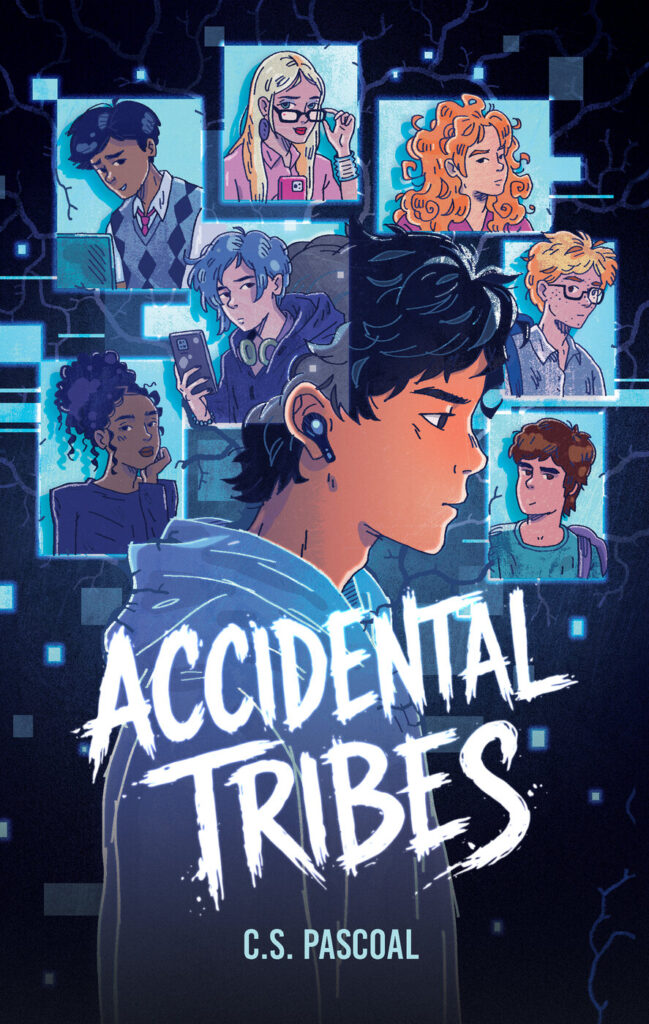
The questions raised by the Census echo the digital dilemmas at the heart of Accidental Tribes. In C.S. Pascoal’s illustrated YA mystery, eight teenagers in Experiment 359 confront anonymous accounts, hacked grades, AI-generated humiliation, and the pressure to manage how they appear online.
The story doesn’t treat technology as only a threat. For teens, it can also mean connection, community, access to ideas, and a creative voice. The hard part is learning to recognize when a digital space is supporting those things, and when attention, status, or fear is beginning to steer the experience.
That makes fiction a useful partner to a report. Data gives us a wider pattern; characters give us a way to talk through the choices and feelings behind it. The free educator resources and discussion guides are designed to help teachers bring those conversations into the classroom. Parents can also explore the book’s social-media and family discussion resources.

What’s the best next step?
Use the Census as a prompt, not a scorecard. Ask a teen what they think the report gets right, and what it might be missing about their own online life. You may learn that an app is mostly a way to stay connected, that a feed is making them feel worse, or that they are using AI in ways you hadn’t expected.
Then choose one small next step together: a conversation about how recommendations shape attention, a plan for phone-free sleep, or a classroom exercise in checking whether an image is real. We don’t need to solve every digital challenge in one conversation. We do need to keep the conversation open.
Read the research: Common Sense Media’s 2026 Tech and Media Use report and 2026 AI Use report.
Explore the story: Learn more about Accidental Tribes or browse the free classroom guides.