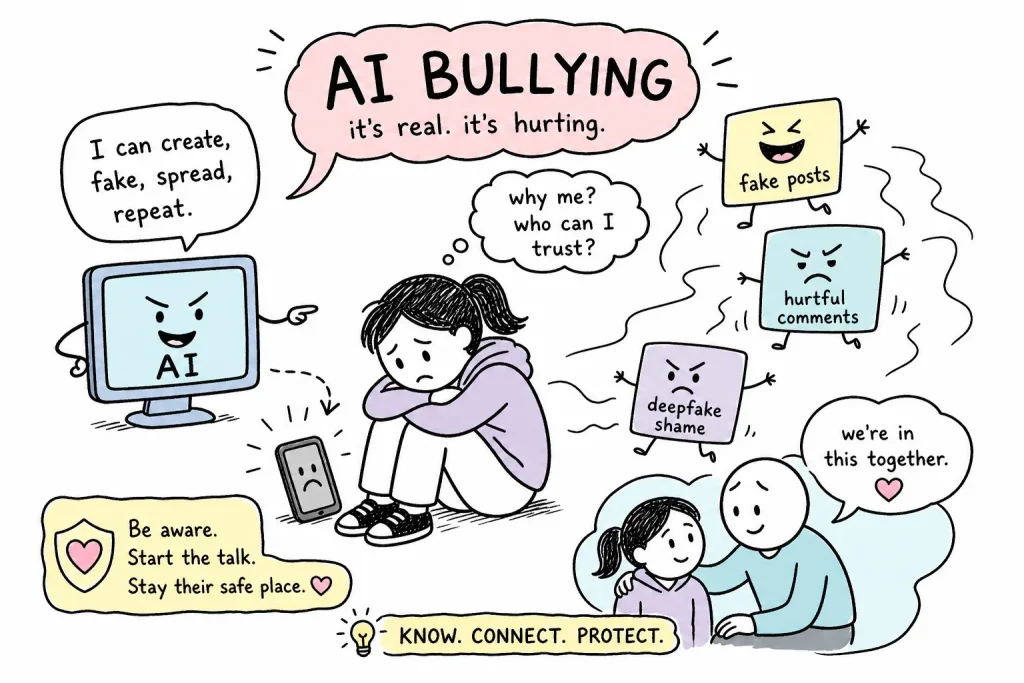
This isn’t a hypothetical. It’s a pattern playing out across the country, and the numbers behind it are stark. NCMEC’s CyberTipline received 67,000 reports of AI-generated child sexual abuse material in 2024, a number that jumped to 440,000 in just the first six months of 2025. A RAND survey found that 22% of high school principals reported at least one deepfake bullying incident during the 2024, 2025 school year. This isn’t a future problem. It’s a present one.
This article walks you through what AI-enabled cyberbullying targeting teens actually looks like, which tools are behind it, warning signs to watch for, a concrete response plan, and where the law still leaves families to figure things out on their own. And as a side note: sometimes the sharpest warnings about a digital crisis come wrapped in a story. That matters here, and we’ll come back to it.
What AI cyberbullying of teens actually looks like today
From face swaps to fake voices: a new harassment playbook
The word “deepfake” has become so generic that it stops meaning anything. The categories of AI-enabled cyberbullying teens face are worth naming clearly. Face-swap videos place a real student’s face into humiliating or explicit clips. AI-generated text impersonation creates fake conversations that look like they came from the victim, complete with their name and photo. Synthetic voice cloning fabricates audio of a teen saying things they never said, which can then be sent to teachers, parents, or peers. Each category carries its own damage, and all three are accessible to any student with a smartphone.
The Lancaster, Pennsylvania case, which ran from November 2023 through May 2024, makes this concrete. Two students allegedly created and shared hundreds of sexualized deepfake images. Authorities identified 60 victims, 59 of them minors, all in a single school district, in a single year.
Nudification and image-based abuse: the most damaging category
Non-consensual intimate image generation, sometimes called “nudification,” is the fastest-growing and most psychologically devastating category of AI harassment teens face. Thorn’s national survey found that 1 in 17 teens ages 13 to 17 reported being a direct victim. The harm here isn’t just embarrassment. It carries a unique weight of shame and social damage that other forms of harassment simply don’t.
A related threat is deepfake sextortion: fabricated explicit images used as leverage to demand money or more content from the victim. This is extortion, but with AI doing the forgery work. The teen doesn’t need to have done anything wrong. The image was never real. That point is almost impossible for a frightened teenager to hold onto when the content is already spreading.
How AI cyberbullying of teens spreads faster than traditional harassment
Unlike a rumor, a screenshot of an AI-generated image doesn’t fade. The content looks convincing enough to fool peers, AI moderation tools on most platforms struggle to detect synthetic media quickly, and once copied, the content can be reshared indefinitely. That’s what makes speed of response so critical, every hour of delay is another hour of circulation, and the psychological damage compounds with every new person who sees it. This detection lag is a documented limitation, not a temporary glitch, and it’s one of the reasons AI-enabled cyberbullying is so hard to contain once it starts.
The apps making this shockingly easy to do
Consumer face-swap apps teens already have on their phones
Apps like Reface, FaceApp, Zao, and FaceMagic were designed for entertainment: putting your face in a movie scene, aging yourself for fun, swapping into a celebrity photo. No technical skill required. No subscription. Five minutes and a classmate’s selfie. Parents who assume deepfakes require sophisticated equipment or expertise are working from an outdated picture of how this actually works.
The discovery pipeline is worth understanding. TikTok is repeatedly cited as a place where teens first learn about these tools, while Snapchat appears most often as the platform used to circulate the resulting content among students. Creation and distribution happen in the same digital ecosystem where teens already live.
Nudification tools and general-purpose chatbots
A separate and more dangerous category of tools exists specifically to generate explicit images from ordinary, fully clothed photos. Clothoff is one of the most explicitly named apps in U.S. school incident records. Unlike face-swap apps, these tools have no legitimate entertainment purpose, they exist to strip, and teens are using them on classmates.
General-purpose AI chatbots have also been exploited to generate deepfake content. This isn’t about rogue, obscure apps hiding in dark corners of the internet. Some of these tools are mainstream, which is the part that should stop you cold.
Signs of AI cyberbullying teens face: why detection is so hard
AI moderation tools do exist, but their real-world accuracy is far weaker than their marketing suggests. State-of-the-art detectors can reach around 91 to 92% accuracy on controlled benchmark datasets, but that figure drops to roughly 60% on out-of-distribution deepfakes found in real school environments. Most school monitoring systems weren’t built with synthetic media in mind at all. By the time content is flagged, it’s often already been seen by hundreds of people.
Warning signs your teen is being targeted by AI cyberbullying
Behavioral red flags that signal something is wrong
Parents often notice something has shifted before their teen says a word. Watch for sudden withdrawal from social media or complete deletion of accounts, dramatic drops in school attendance, sleep disruption, panic-like responses to phone notifications, unexplained crying, loss of appetite, and increased isolation. None of these signals confirm anything on their own, but a cluster of them warrants a calm, non-accusatory conversation.
The key word there is calm. A teen who senses judgment or panic from a parent will shut down. Your demeanor in that first conversation sets the tone for everything that follows.
Digital and social signals worth checking
In the digital space, watch for sudden changes in who your teen is talking to, a shift from public to private or anonymous accounts, unexplained new group chats, or classmates behaving differently toward your teen in person. Pay attention to the reverse as well: a teen who used to be open about their online life and suddenly goes very quiet about it may be dealing with something they don’t yet have words for.
The goal of noticing is to open a door, not to conduct surveillance or interrogation, but to make yourself the kind of adult your teen can actually come to.
A response plan that works when every minute counts
The first hour: preserve, protect, don’t delete
Start with emotional safety. Reassure your teen immediately: they are not in trouble, and this is not their fault. That sentence matters more than anything else you’ll do in that first hour. Next, preserve evidence once, through an adult, without asking the teen to keep re-opening the material. Document screenshots, usernames, timestamps, platform names, and any relevant URLs. Then contact the platform immediately using harassment, impersonation, or non-consensual content reporting tools.
Do not delete the original evidence before reporting. Metadata and timestamps matter for investigations, and this is one of the most common mistakes families make. Removing content prematurely can limit what law enforcement is able to do later.
Reporting to schools, platforms, and law enforcement
You don’t have to pick just one channel. Platform reporting is the first line for removal. School notification is necessary when classmates or school-connected accounts are involved. Law enforcement becomes relevant when the content involves sexual imagery of a minor, threats, or extortion. NCMEC’s CyberTipline is a specific resource for sexual content involving minors, and it’s worth knowing that number before you need it.
All three channels can run simultaneously. Schools can coordinate counseling and supervision. Platforms can remove content. Law enforcement can investigate. These processes don’t cancel each other out.
Mental health follow-up that actually sticks
One conversation is not enough. After an AI cyberbullying incident, teens need check-ins for weeks, not days. Watch for school refusal, self-harm statements, or expressions of hopelessness, and escalate to a professional quickly if those appear. Counselors and therapists who understand online victimization are especially valuable here, because they can work with the specific shame dynamics that image-based abuse creates.
Your steadiness during this period matters as much as any practical step you take. Teens are watching how the adults around them respond, and they’re deciding whether those adults can handle the truth of what’s happening to them.
Where the law and school policies still leave families exposed
What the TAKE IT DOWN Act covers and where it stops
The TAKE IT DOWN Act is the first major federal law directly targeting nonconsensual intimate deepfakes. It criminalizes sharing such content and requires platforms to remove it after notice, genuine, meaningful progress. But the law is targeted at intimate visual depictions. Content that humiliates without sexual imagery, a fake voice clip, an AI-generated text impersonation, may fall outside direct federal coverage unless another existing statute applies.
That gap is real, and families should understand it. The law helps significantly in the most severe cases of AI cyberbullying targeting teens. It doesn’t yet cover the full range of harm that AI tools can inflict.
State laws and the coverage patchwork
States including California, Texas, Washington, and Virginia have their own deepfake statutes, but coverage varies widely. Some states still lack comprehensive protections for non-intimate AI-generated harassment. A teen’s legal options often depend on geography as much as the severity of the harm, which is not how protection should work, but it’s where things stand right now.
The school policy gap parents should know about
Most school bullying and acceptable-use policies were written before generative AI existed. They often don’t mention deepfakes, AI-generated content, or synthetic media, which creates real ambiguity around evidence collection, discipline thresholds, and parent notification. Ask your school district directly: does your bullying policy explicitly address AI-generated content? If the answer is no, that conversation is worth having at the next PTA meeting or school board session.
You’re not being alarmist. You’re being ahead of a problem that’s already in the building.
Why a good story might open the conversation your teen won’t have
Research consistently shows that teens who feel lectured at shut down. But teens who see themselves reflected in a character stay engaged. A novel that depicts AI harassment, viral humiliation, and institutional failure through the eyes of characters their own age gives teens language for experiences they might not have words for yet. It also gives parents a natural opening. “What did you think about how she handled that?” lands very differently than “We need to talk about deepfakes.”
That’s part of what makes Accidental Tribes worth putting in your teen’s hands. Written by C.S. Pascoal and published by Prospera Books, this illustrated YA mystery launches September 22, 2026. It follows eight teenagers who face hacked systems, viral humiliation, and the weaponization of digital tools against young people with no obvious adults in their corner. It doesn’t moralize, and that matters, because teens will close a book that lectures them. Teens who have lived through online harassment, or who worry they might, will find something true in these characters. Educators looking for a classroom text that opens a real conversation about AI-enabled cyberbullying, identity, and who gets to control your story online will find discussion resources already built in. Free first chapters are available online, and pre-orders are open now.
What you actually need to carry out of this
AI cyberbullying targeting teens isn’t a technology problem with a technology solution. It’s a people problem: kids with more digital power than emotional scaffolding, and adults handed a rulebook that didn’t anticipate this moment. The tools are easy to use, the content spreads fast, and the law is catching up but isn’t there yet.
Here’s what you can do right now: learn to recognize the forms AI harassment takes, know the behavioral warning signs, build your response plan before you need it, understand where legal protection exists and where it doesn’t, and don’t underestimate how much a conversation sparked by the right story at the right time can do.
The teens navigating this right now are not fragile. They just need adults who take this seriously. If you’re reading this article, you already do. Pick up Accidental Tribes, read it alongside your teen, and let the story do some of the heavy lifting.