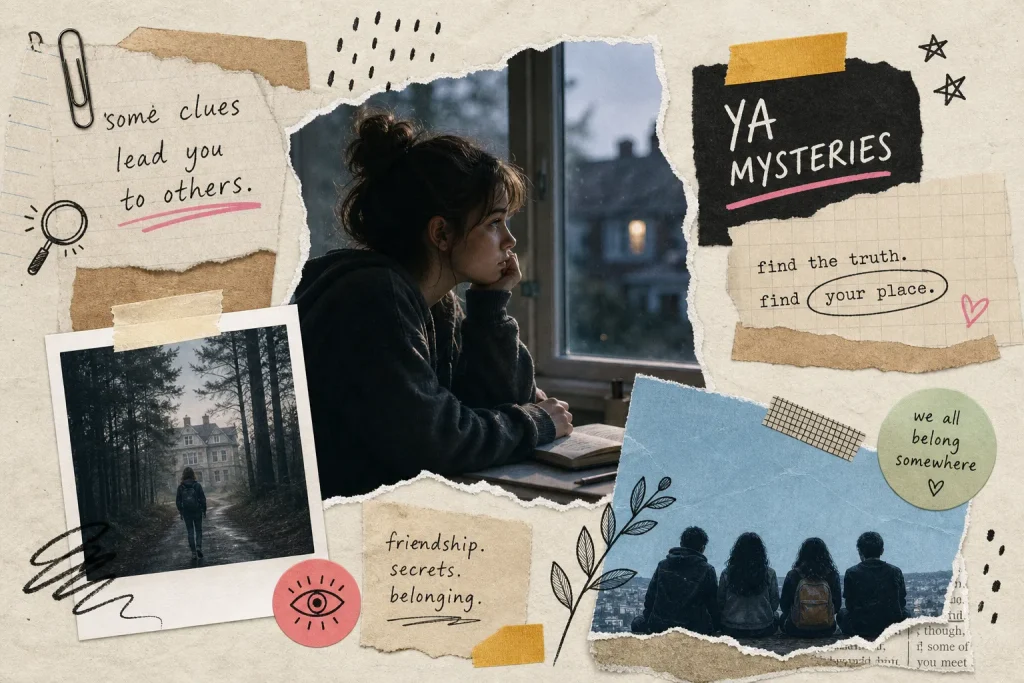
The best ensemble YA mysteries have always understood something that takes most adults years to articulate: belonging during the teen years isn’t a nice-to-have. It’s the whole thing. Studies on school connectedness show that a strong sense of school belonging in adolescence is linked to lower rates of depression and anxiety in later years, a finding that holds across demographic groups and school settings. The genre has been mining that emotional truth long before the research caught up. When a book gets it right, you don’t just finish it. You feel recognized by it.
That’s the standard every book on this list is held to. And topping the 2026 column is Accidental Tribes by C.S. Pascoal (Prospera Books, launching September 22, 2026): eight defiant teenagers, one forgotten classroom called Solitaria, and a mystery layered with institutional secrets, AI-generated content, and no easy answers. More on that shortly. First, let’s talk about what makes this genre work.
Why belonging and adolescence are the real pull of ensemble YA mysteries
The “whodunit” is the vehicle, not the destination. The question every great ensemble YA mystery is really asking is: who am I when I’m forced to be honest with people who have no reason to know me? That question lands differently at fifteen than it does at thirty-five. Adolescence is the developmental window when the need to belong is most acute, most painful, and most consequential. School-set mysteries feel urgent precisely because they mirror what teen readers are already living.
The ensemble format does something especially clever. Multiple suspects means multiple perspectives, and multiple perspectives means the reader never quite knows where they stand. That’s not just good plotting, it’s a faithful reproduction of what adolescent belonging feels like in high school. You’re always reading the room. You’re always slightly unsure. The best books in this genre weaponize that uncertainty against you in the best possible way.
What separates a great ensemble YA mystery from a forgettable one comes down to a few specific craft choices: a cast where everyone has a reason to hide something; a setting that creates inescapable proximity (a school, a detention room, a forgotten classroom); and at least one narrator you’re not entirely sure you should trust. These aren’t arbitrary craft decisions. They mimic the actual social experience of belonging and adolescence, the forced closeness, the masked vulnerability, the slow reveal of who people actually are underneath the version they perform for everyone else. Every book on this list was chosen with those criteria in mind.
Accidental Tribes: the 2026 ensemble mystery fans have been waiting for
Eight teenagers land in Solitaria, a forgotten classroom that exists just far enough outside the school’s normal orbit to feel like its own world. They have nothing obvious in common except defiance. Then the buried things start surfacing: an unsolved death, stolen funds, and institutional lies that go deeper than any of them expected. Accidental Tribes by C.S. Pascoal (Prospera Books) launches September 22, 2026, and it sits unmistakably in the tradition of the best the genre has produced.
What sets it apart from the crowded YA mystery shelf is that its contemporary stakes aren’t decorative. AI-generated content, hacked systems, anonymous accounts, and viral humiliation aren’t plot garnishes here; they’re woven into the mystery itself. For teen readers who live inside these dynamics every day, that specificity matters. It’s the difference between a book that nods at the present and one that actually lives there.
The illustrated format gives each member of the ensemble cast a visual distinctiveness that helps readers track eight characters without losing the thread, something particularly useful for readers who prefer a visual anchor alongside the prose. This isn’t a debut arriving without context: according to publisher materials, the book was stress-tested by a Teen Advance Reader Council, reviewed by Midwest Book Review and The Children’s Book Review, and authored by a Cartier Women’s Initiative Award-winning writer. Free first chapters are available online now, so you don’t have to take anyone’s word for it. Pre-order is open ahead of the September 22 launch.
The book that started it all: why One of Us Is Lying still holds up
Karen McManus published One of Us Is Lying in 2017, and the premise read like a dare: five teens walk into detention, one doesn’t walk out alive. The ensemble POV structure let readers inhabit multiple versions of guilt simultaneously, trying on each narrator’s secrets like a jacket that almost fits. What made it sticky wasn’t the twist, it was how differently five teenagers experienced the exact same moment depending on where they sat in the school’s social hierarchy. As much as it’s a book about a crime, it’s a book about the cost of belonging and adolescence when the social order decides who matters.
YALSA named it a Quick Pick for Reluctant Young Adult Readers, which tells you something about its accessibility. Common Sense Media flagged it for raising “lots of ethical questions” and providing “good discussion topics,” which tells you something about its depth. The sequels expand the world without losing the claustrophobic tension of the original. McManus’s broader catalogue, Two Can Keep a Secret, You’ll Be the Death of Me, The Cousins, each brings school-set tension and ensemble dynamics worth exploring. They’re the natural next step before branching out to newer voices.
Ensemble-cast YA mysteries with school-set twists worth reading next
Holly Jackson’s A Good Girl’s Guide to Murder takes the ensemble mystery in a different structural direction: its journalistic POV gives the protagonist a reason to be in everyone’s business, and the cold-case framing means the group dynamic extends backward in time, implicating people who weren’t even in the room. It’s the right next read if what you loved about One of Us Is Lying was the feeling of peeling back layers and finding something worse underneath each one.
Maureen Johnson’s Truly Devious series, set at the atmosphere-drenched Ellingham Academy, does something different: it implicates the institution itself. A decades-old kidnapping, a school built by an eccentric and possibly criminal founder, and a protagonist whose relationship with the truth is more complicated than it first appears. The boarding school setting creates exactly the kind of inescapable proximity that makes ensemble mysteries work. If the slow-burn institutional mystery was your favorite part of One of Us Is Lying, start here.
For more recent energy in the genre, 2024 delivered several strong entries. Where Sleeping Girls Lie by Faridah Àbíké-Íyímídé brought a school-centered mystery with the kind of social tension that feels both specific and universal. How We Fall Apart by Katie Zhao centers a prep-school death and escalating secrets among a friend group; it built significant momentum on BookTok because the social belonging anxiety it captures feels contemporary and real. Both prove the genre isn’t coasting on McManus’s momentum. New voices are genuinely extending what ensemble YA mystery can do.
YA mysteries built on unreliable narrators and buried institutional secrets
Unreliable narrators in YA mystery do something distinct from straight-up whodunits: they put the reader in the position of a teenager who has learned not to fully trust what adults or institutions tell them. That’s a specific kind of belonging anxiety, the kind that comes from suspecting the system was never designed with you in mind. The best books in this lane separate narrators who know more than they’re telling from narrators who genuinely misread the situation, and the latter are often the more unsettling.
E. Lockhart’s We Were Liars remains one of the most frequently recommended unreliable-narrator YA mysteries in teen and BookTok-adjacent reading spaces, and for good reason. The narrator’s limitation is the entire architecture of the book. Kit Frick’s I Killed Zoe Spanos is another consistent recommendation in this lane, built around a narrator whose reliability you spend the entire novel negotiating. Both reward readers who want to feel genuinely uncertain about what they’re being told.
For books where institutional deception is the real wrongdoing, Accidental Tribes belongs at the top of the list. Solitaria isn’t just a clever setting, it’s a symbol of what happens when schools create spaces designed to disappear students rather than serve them. The buried secrets in the novel reflect something teen readers recognize intuitively: that the people running the institution don’t always have the institution’s most vulnerable members in mind. That recognition is why books exploring belonging and adolescence through this lens hit differently. They don’t just solve a crime. They name something.
How to choose your next read from this list
Think about what pulled you into the last book you couldn’t put down, then use that as your compass. If the group dynamic and multiple POVs were everything, start with Accidental Tribes or Holly Jackson. If the slow-burn institutional mystery appealed more than the social drama, go straight to Truly Devious. If the specific social-hierarchy tension of One of Us Is Lying was the hook, revisit McManus’s back catalogue before branching out. This isn’t about ranking books against each other, it’s about knowing yourself as a reader well enough to make a good match.
The YA mystery boom isn’t a trend chasing an algorithm. It’s a response to something real: teenagers navigating systems they didn’t design, social landscapes that shift without warning, and institutions that sometimes protect their own interests before protecting the people inside them. The best books in this genre don’t offer false comfort. They offer recognition. And recognition, it turns out, is one of the most powerful forms of belonging and adolescence has to give.
Accidental Tribes launches September 22, 2026. Pre-order is open now, and the first chapters are available online for free. If you’ve ever loved a book because it made you feel like someone understood exactly what it costs to be the new person in a room full of strangers, this one was written for you.