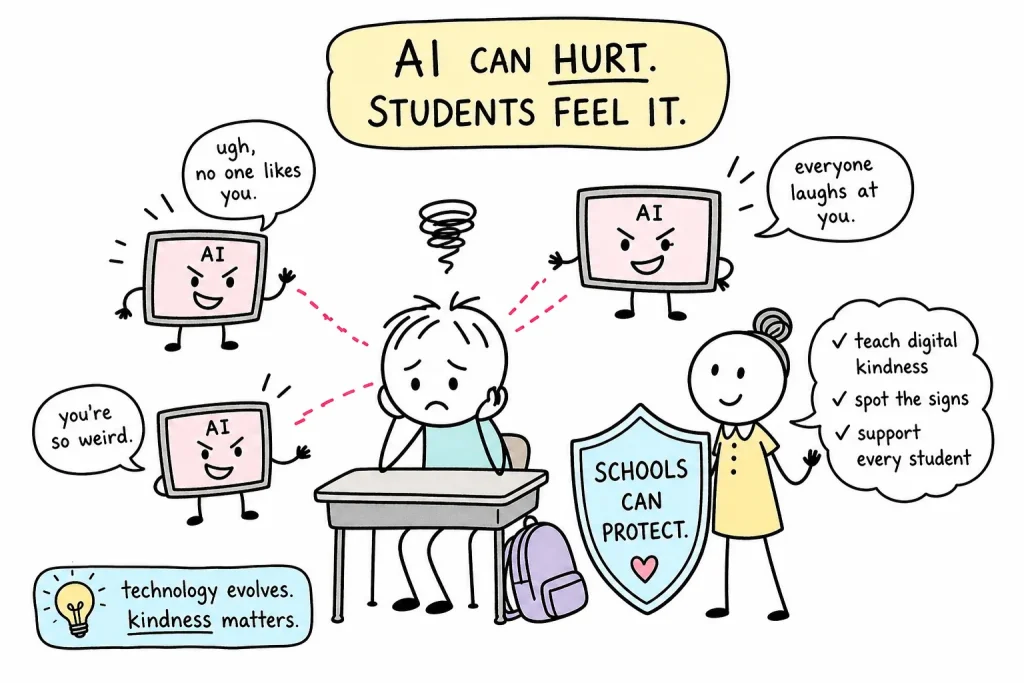
How is AI being used to bully students in school? For many teens, the answer is already personal. What happened at Westfield High School in New Jersey isn’t a hypothetical, and variations of it are unfolding in school districts across the United States right now. AI tools marketed as creative shortcuts are being repurposed to humiliate, threaten, and silence students. The primary forms include deepfake image generators, “nudify” apps, voice cloning software, and AI-driven anonymous harassment accounts. According to a RAND Corporation survey, 13% of K-12 principals reported at least one AI deepfake bullying incident during the 2023, 2025 school years. Experts say this likely undercounts true incidence, since many incidents go unreported and detection gaps are significant. And while policy, law, and detection tools are all scrambling to catch up, fiction is starting to name what we’re only beginning to understand. Books like C.S. Pascoal’s Accidental Tribes are giving teens and parents a shared language for dynamics that most adults can’t yet see clearly, more on that below.
How AI Is Being Used to Bully Students in School: Tools and Methods
Deepfake images and the rise of “nudify” apps
Consumer-grade AI image generators and specialized “nudify” apps allow virtually anyone to superimpose a student’s face onto fabricated sexualized imagery. No technical expertise required, many of these tools are free or low-cost and accessible from any phone or laptop. The Westfield case and a similar incident at Beverly Hills Unified School District both involved this method: students using real yearbook or social media photos as source material and generating content that looks convincingly real. Many platforms have since added content filters, but enforcement varies widely across services, and workarounds circulate quickly in student networks. The content looks real enough to cause real harm regardless of its authenticity, and that’s precisely the point.
Voice cloning and synthetic audio
Text-to-speech and voice cloning tools can replicate a person’s voice from a surprisingly short audio sample. The Pikesville High School case in Maryland showed exactly how damaging this can be: a school athletic director used off-the-shelf software to generate a fake audio clip of the principal making racist remarks. That case involved an adult targeting another adult, but the same tools are accessible to any student. Fabricated conversations, invented threats, made-up confessions attributed to a peer or teacher, voice cloning can manufacture “evidence” that sounds irrefutable.
Anonymous harassment bots and AI-generated accounts
AI-generated social media profiles and chatbot-driven anonymous accounts can send sustained, coordinated waves of targeted messages. They post fabricated quotes, flood comment sections, and send harassing DMs at a scale no single person could maintain. Researchers who study online victimization note that anonymity compounds psychological harm in a specific way: the targeted student can never be sure who’s behind it, which keeps fear and hypervigilance running indefinitely. That sustained uncertainty can be one of the most destabilizing aspects of AI-enabled harassment.
Real Cases from US Schools That Have Already Happened
One of the most important things to understand about AI-enabled school bullying is that it isn’t theoretical. These incidents have specific names, specific schools, and students who are living through something they never volunteered for.
At Westfield High School, at least 30 female students were victimized when a student created AI-generated pornographic images using their real faces. The district suspended one student and updated its cyberbullying policies to explicitly address AI. In Beverly Hills, five middle school students were expelled in March 2026 for creating and sharing explicit deepfake images of female classmates. Both cases involved free, commercially available tools, and reporting on the incidents established that the students understood the nature of what they were creating and sharing.
The cases aren’t limited to high school. In Louisiana, AI-generated nude images of female students circulated among peers at a middle school, leading to criminal charges against two boys. One victim was initially expelled after confronting the student she accused of creating the images. In Wisconsin, a 13-year-old used a classmate’s photo from a bat mitzvah celebration to generate a deepfake nude that was shared on Snapchat. These aren’t edge cases. As Dr. Will Durgin, Director of Student Wellbeing at Raptor Technologies, put it: “This isn’t just a middle school or a high school problem. You can see this as early as kindergarten.”
Adults aren’t exempt from this pattern either. In Pennsylvania, a mother allegedly generated AI-compromising images of her daughter’s cheerleading rivals and sent them to a coach. Schools need policies that account for harassment originating outside the student body, because it’s already happening.
What the Data Tells Us About How Widespread This Really Is
The RAND principal survey is the clearest U.S. data point we have: 13% of K-12 principals reported at least one AI deepfake bullying incident during the 2023, 2025 period. Among high school principals, that number rises to 22%. Among middle school principals, it’s 20%. Elementary principals reported 8%. These numbers represent only what was reported to school leadership, which makes a second figure even more striking.
A Center for Democracy and Technology survey found that 40% of students were already aware of a deepfake involving someone at their school, compared with 29% of teachers and only 17% of parents. That gap isn’t just a communication problem, it’s where harm compounds. Students are absorbing and managing a crisis that the adults around them can’t fully see. Jennifer DiMaio, assistant superintendent at Valley Stream Central High School, captured the pace of the problem well: “I don’t think anyone is going to be immune to this, because everybody has a device and everybody has access to AI, and it’s generating at a rate much faster than our comprehension of it.”
An EdWeek Research Center survey found that 67% of educators believed students had been misled by a deepfake, yet that same survey showed significant gaps in how schools are equipped to respond. That disconnect between awareness and readiness is exactly where students fall through the cracks.
How AI Is Being Used to Bully Students in School, First 24-Hour
Response Plan
Step 1: Preserve the evidence without spreading the harm
The instinct when you see something horrifying is to either delete it or forward it to everyone who needs to know. Both responses damage any investigation that follows. Save the original post, URL, username, timestamp, and surrounding context. Keep the native thread or file, not just a screenshot. Do not forward the content to more people than absolutely necessary. If the material includes explicit imagery of a minor, use NCMEC’s Take It Down service: it generates a hash of the image on your device without ever uploading the file itself, then shares that hash with participating platforms so matching content can be detected and removed.
Step 2: Report to the platform and document everything
Use the in-app abuse reporting tools before blocking or deleting anything, because blocking can destroy your ability to preserve evidence. Keep the confirmation number from every report you submit. Document each step in a separate incident log: what happened, when, where it appeared, who was involved, and how the student was affected. If the content is AI-generated, flag it as synthetic media in the report. Parents and school administrators should coordinate their platform reports so the same incident isn’t getting contradictory submissions from multiple accounts.
Step 3: Protect the student’s immediate wellbeing, then investigate
The targeted student’s safety and emotional state come before the investigation. Move the student into a supportive, private setting and assign one trusted adult as their consistent point of contact throughout the response. Provide access to counseling, and monitor for academic avoidance, attendance drops, or signs of escalating distress. Alert staff to watch for retaliation and continued redistribution.
Studies on adolescent development, including Thorn’s research on teen responses to deepfake content, consistently find that teen victims of AI-generated sexual imagery experience shame, hypervigilance, depression, and in severe cases suicidal ideation. Thorn found that 84% of teens said deepfake nudes harm the person depicted, naming emotional and reputational damage as the primary reasons. The investigation can wait until the student is stable.
The Policy and Legal Realities Schools Can No Longer Sidestep
When AI-generated content is sexual in nature and affects a student’s ability to participate in school, it likely triggers Title IX obligations. Schools should route these incidents through their Title IX coordinator alongside the bullying response process, not instead of it. Several states have already updated their cyberbullying definitions to explicitly include AI-generated content. Illinois H.B. 3851, effective July 1, 2026, adds unauthorized digital replicas to the school cyberbullying definition. Louisiana S.B. 346, effective August 1, 2026, prohibits the use of deepfake material against K-12 students. Colorado and New York have also moved to expand their relevant definitions, according to legislative tracking reports. Contact law enforcement when content involves nonconsensual intimate imagery of a minor, credible threats, or potential child sexual abuse material.
On detection tools: Reality Defender, Hive Moderation, Sensity, and FotoForensics all exist and can help, but real-world accuracy ranges from roughly 70% to 85% on standard content and drops significantly on low-resolution or newly generated files. No single tool is reliable enough to serve as sole evidence. The most defensible approach is triangulation: run multiple detectors, inspect metadata and compression artifacts, and preserve the original file for any law enforcement chain-of-custody review. Don’t promise families that a single tool can definitively prove a file is AI-generated.
Why Fiction Reaches Teens When Facts Alone Can’t
Studies on adolescent development find that teens regulate difficult emotions more effectively through narrative than through direct instruction or news reports. When a teenager reads about a character experiencing viral humiliation, anonymous harassment, or AI-generated betrayal, they’re not just entertained. They’re rehearsing responses, building vocabulary for something they may have no other words for, and finding proof that someone else understands what they’re going through. This is precisely why teachers and librarians are increasingly turning to YA fiction as a discussion bridge for topics that feel too raw to address directly in a classroom.
C.S. Pascoal’s illustrated YA mystery novel Accidental Tribes (Prospera Books, launching September 22, 2026) places eight defiant teenagers inside a story woven through with AI misuse, anonymous accounts, viral humiliation, and institutional deception. It doesn’t lecture. It immerses. For parents who don’t know how to start the conversation, reading the same book as their teen creates a shared reference point without pressure. For teachers, the novel comes with classroom and library discussion resources built around digital citizenship, AI ethics, and identity. For teens themselves, seeing their exact reality reflected in fiction, without being talked down to, can be the thing that finally makes them feel seen enough to speak up. First chapters are available online ahead of the September 22 launch, making it easy for a teacher or parent to decide if it’s the right fit before committing.
The Most Powerful Tool Isn’t an Algorithm
The ways AI is being used to bully students in school are no longer hypothetical. These incidents have real names, real schools, and real kids who didn’t ask to find themselves at the center of something this damaging. The technology is moving faster than most district policies, and the gap between what students are experiencing and what the adults around them can see is dangerously wide.
When a crisis does land on your desk, a few principles make the difference between a response that helps and one that compounds the harm. Preserve evidence without spreading it further. Know your legal and reporting pathways before you need them. Keep the targeted student’s wellbeing at the center of every decision. These aren’t complicated principles, but they require deliberate preparation, not improvisation under pressure.
The most powerful tool against AI-enabled bullying isn’t a detection algorithm. It’s a teenager who trusts an adult enough to say what’s happening. As Laura Tierney of The Social Institute put it: “If kids encounter things like deepfakes, they need to know they can talk to their parents without getting in trouble.” Build that trust now, before the crisis arrives. The conversation you have today might be the one that changes everything.