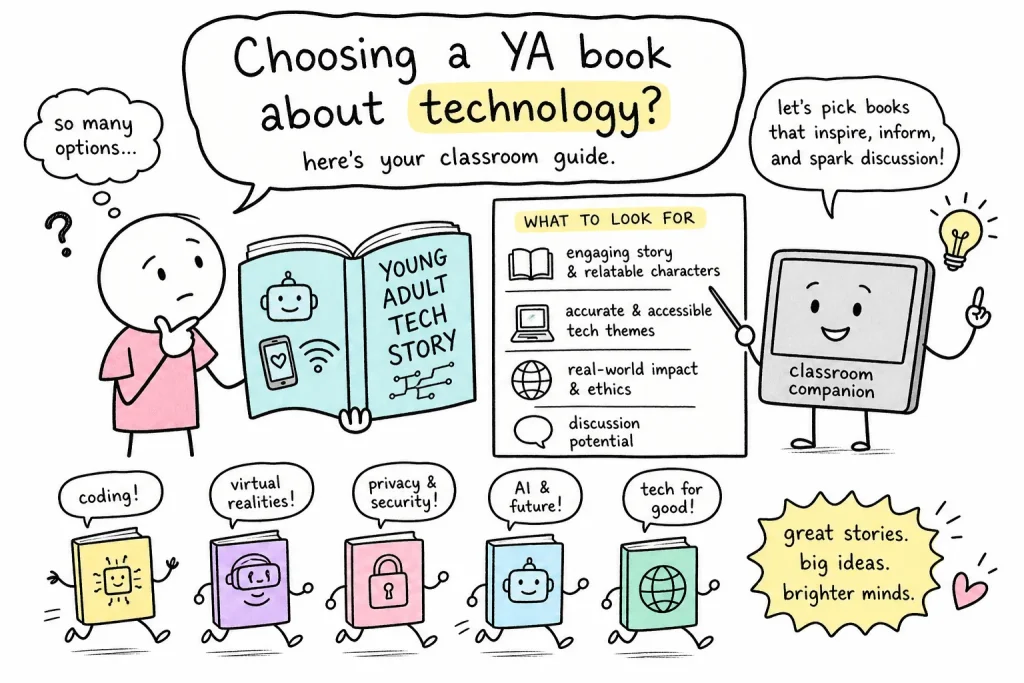
The good news is that this decision has a logic to it. Once you see the framework, you can run any title through it in about fifteen minutes and know whether it belongs on your shortlist. By the end of this guide, you’ll have that framework, a few specific titles worth pulling, and the beginning of a unit plan with real learning objectives and assessments behind it. No guessing.
Why Choosing a YA Tech Novel Is Harder Than It Looks
The YA market is flooded with books that gesture toward technology but weren’t designed with a classroom in mind. A novel can be genuinely great for a teen reading alone on a Saturday and still be nearly impossible to teach. Too thin on discussion hooks. Too dependent on plot momentum to slow down for analysis. Too niche in its tech focus to connect with broader learning goals. The teacher’s job is to evaluate books on a completely different axis than a reader would, and that’s a skill most of us build by accident after one or two rough units.
When the wrong book takes over a unit, the damage is incremental and then total. Students disengage within the first two weeks. Discussion goes flat. You find yourself improvising prompts that the book doesn’t naturally support, and the whole unit starts feeling like one long improvisation. The fix isn’t more lesson planning after you’ve chosen. It’s better selection criteria before you choose. Think of it as protecting yourself and your students from a mismatch that no amount of good teaching can fully rescue.
How Do I Choose a YA Book for a High School Classroom Unit on Technology? Start with These Four Criteria
Thematic relevance to your students’ real digital lives
The book’s technology theme needs to land close enough to students’ actual experience that they recognize something true in it. AI-generated content, social media pressure, anonymous accounts, viral humiliation, algorithmic feeds that shape what they see and believe: these are things students in 2026 are living inside, not reading about as distant dystopia. When you preview a title, read the first chapter and ask yourself whether a student in your class would see their own world reflected back. Abstract science fiction can work for some units; grounded digital realism works for most.
Built-in discussion potential, not just a gripping plot
Good class discussion isn’t “what happened next.” It’s “what does this mean, and what would you do?” The books that generate real Socratic seminars are the ones with ethical forks in the road: moments where characters make choices that students can interrogate from multiple angles. When you’re previewing a title, scan for scenes where a character faces a genuine dilemma with no clean answer. If every major decision in the book is obviously right or obviously wrong, the discussion will be flat by design.
Reading level and the engagement trap
Lexile scores are a starting filter, not a verdict. For grades 9 through 12, typical text complexity ranges run from roughly 900L to 1440L depending on grade level and state framework. But here’s the thing: a book that pulls students forward at 800L beats one that loses them at 1100L. A well-known title like Feed by M.T. Anderson sits at approximately 770L, below typical high-school grade bands, and it still earns its place in 9th and 10th grade units because the thematic complexity is genuinely high. Use Lexile to flag obvious mismatches, then trust your read of the room.
The first chapter as an audition
The first chapter tells you whether real students will finish the book. What you’re looking for: a character the reader roots for immediately, a problem that feels urgent from page one, and a voice that doesn’t condescend. This filter weeds out technically appropriate titles that students will simply stop reading before Chapter 3. If the first chapter doesn’t make you want the next one, your most reluctant readers will close it by Tuesday.
Matching the Right Tech Theme to Your Unit Goals
AI and algorithmic ethics
For units centered on AI, the goal is usually to help students think critically about how artificial intelligence shapes decisions that affect real people. You need a book where AI isn’t just backdrop, where it drives conflict, raises genuine moral questions, and gives students something to argue about. Scythe by Neal Shusterman handles AI governance and delegated moral decision-making with enough complexity to support real argument writing. Show Us Who You Are by Elle McNicoll approaches AI ethics through the lens of neurodiversity and the treatment of human-like beings, which opens different conversations around dignity and consent.
Social media, identity, and digital citizenship
For units on digital life, you need books where online identity, algorithmic influence, and the social costs of being seen, or deliberately unseen, are central to the story, not incidental. Don’t Read the Comments by Eric Smith is a direct fit for discussions of online harassment and virtual community. These books work especially well when paired with a short nonfiction source, a news article or data visualization, that bridges the fiction to students’ own platforms and habits. Standards like RI.9-10.7 anchor that cross-text work cleanly.
Surveillance, privacy, and civil liberties
For units with a civics angle, Little Brother by Cory Doctorow and Feed by M.T. Anderson both open up questions about institutional power, data collection, and what people trade away for convenience or safety. These pair naturally with argument writing standards (particularly W.9-10.1 and W.11-12.1) because they practically demand that students take and defend a position on what limits should exist on surveillance and data use.
Reading Level, Content Warnings, and the Parent Conversation
A practical content-sensitivity checklist
Before you finalize any title, run it through a quick mental checklist: violence level and type, sexual content, substance use, suicidal ideation or self-harm, strong language, and the intensity of any disturbing themes. The goal isn’t to avoid all difficult content. It’s to walk into those conversations with your eyes open and a plan for how to handle them in class. Books addressing AI misuse, viral humiliation, and anonymous online targeting will often include scenes of emotional cruelty that need framing before students encounter them.
How to frame your book choice for administrators and parents
This is the part most teachers skip in their planning and then regret when a parent emails. Prepare a short, clear answer to four questions: what the book addresses, how it connects to standards, what the learning outcomes are, and what safeguards are in place, discussion norms, opt-out alternatives, parent preview option. When you can answer these four questions without hesitating, the approval conversation becomes routine rather than a negotiation. Write it down before the unit starts, not after the first concerned email arrives.
A Shortlist Worth Considering, and One That Earns Its Place
A few strong titles by theme
For surveillance and privacy, Feed and Little Brother remain two well-tested classroom options, each with clear discussion potential and documented use in high school settings. For AI ethics with philosophical weight, Scythe and Show Us Who You Are give you different entry points depending on whether your unit leans toward governance or identity. For social media and digital citizenship, Don’t Read the Comments is the most direct fit and tends to connect quickly with students who are already living in online gaming and creator communities.
Why Accidental Tribes by C.S. Pascoal is worth a close look
When you’re asking how to choose a YA book for a high school classroom unit on technology, one thing that shifts the calculus is whether the book was conceived with teaching in mind from the start, not retrofitted for classroom use after the fact. Accidental Tribes (Prospera Books, C.S. Pascoal) was developed with that in mind. The novel follows eight teenagers who uncover a buried school secret involving AI misuse, viral humiliation, and anonymous social media targeting. Those themes map directly onto what students are already navigating. The manuscript was reviewed by a Teen Advance Reader Council and evaluated by educators before publication, which can matter when you’re making a case to an administrator or school librarian. The ensemble cast of eight distinct characters gives a wide range of students someone to connect with, and the illustrated format makes it accessible for reluctant readers without sacrificing thematic depth.
What “classroom resources included” actually means in practice
Most YA novels, however strong, leave teachers to build all their own scaffolding. Accidental Tribes comes with educator resources designed to support discussion around AI, identity, and digital citizenship, aligned to the kinds of Socratic seminar and evidence-based argument writing that satisfy Common Core standards. For a teacher already stretched thin, ready-made discussion guides aren’t a small convenience. They’re often the difference between a unit that runs and one that drains you. The book launches September 22, 2026, with free first chapters available before that date so you can preview it before committing.
From Book Choice to Unit Plan: A Practical Starting Point
Writing your learning objectives around the text
Once the book is chosen, the unit plan follows a clear logic. Start with what students should be able to do after reading: analyze theme, evaluate the author’s perspective on technology and power, construct an evidence-based argument about digital ethics. Then reverse-engineer the activities that build toward those outcomes. Standards RL.9-10.2 and W.9-10.1 are natural anchors for most tech-themed YA units, covering theme analysis and argument writing respectively, and they hold at the 11-12 band with the same basic structure.
Lesson starters and discussion prompts that get students talking
A few concrete starters that work before the Socratic seminar: a scenario card sort where students label situations as ethical or unethical and defend one choice works well because it forces commitment before conversation. A quick “AI or Not” sort with everyday examples surfaces assumptions students didn’t know they had. A think-pair-share on “Who is responsible when technology causes harm?” rarely produces silence. Keep these short and scenario-based so students are reasoning before they realize they’re doing it. The goal is activated thinking, not a warm-up for its own sake.
Formative assessments that reveal real understanding
The best formative moves for a tech-themed YA unit are ones that push students from opinion to reasoning. Exit tickets that require a claim plus one piece of textual evidence show you whether students are engaging with the book’s ideas or just tracking the plot. Quick argumentative paragraphs, pick one issue, defend a position, cite the text, take five minutes and reveal a lot. Stakeholder impact charts, where students name who is affected by a technology and how, work especially well mid-unit when themes are accumulating. That’s the information you need to adjust the next day, not the day before the essay is due.
Start Here, Then Trust Your Read
Teachers who are figuring out how to choose a YA book for a high school classroom unit on technology often feel stuck because there are too many options and not enough criteria. The framework is simpler than it looked from the outside. You’re filtering for thematic relevance to students’ actual digital lives, genuine discussion potential, an appropriate challenge level, a first chapter that passes the engagement test, and practical classroom support, especially if your planning time is already spoken for. Run a title through those filters and you’ll know fast whether it belongs on your list.
Start with two or three titles from the shortlist. Run them through the criteria. Trust your instinct about what your students need, because you know them better than any review does. If you want a title that addresses AI misuse, social media harm, and teen identity while also coming with educator resources designed for exactly this kind of unit, Accidental Tribes is available with free first chapters before the September 22, 2026 launch. Preview it before you decide.
The right book doesn’t just fill a unit. It gives students a vocabulary for conversations they were already trying to have. That’s worth getting the selection right.