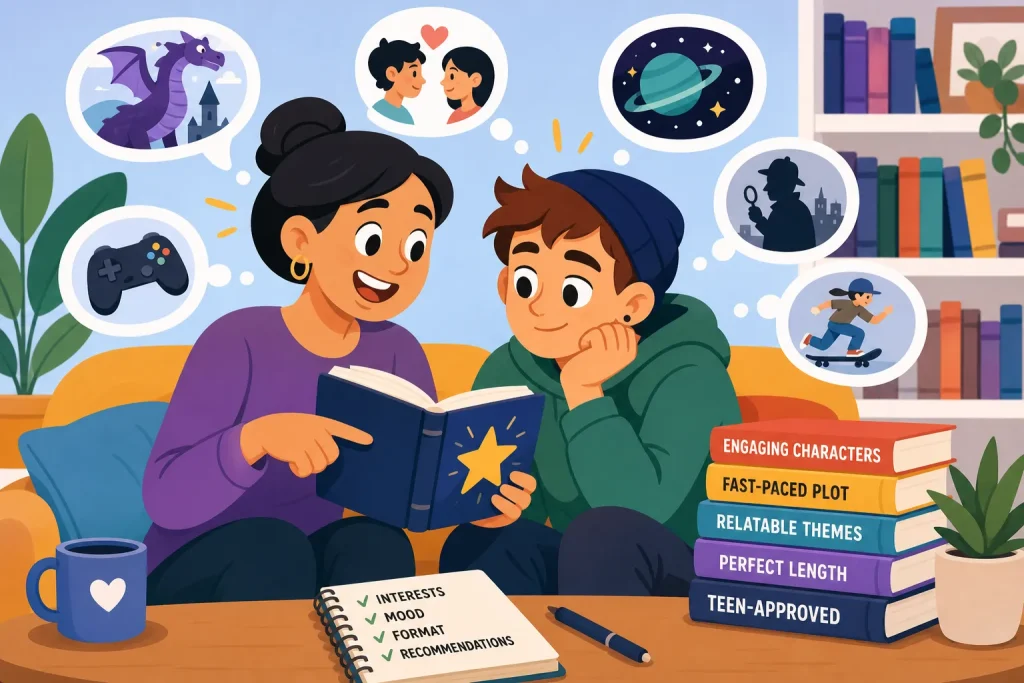
Here’s the thing: most teens who abandon books aren’t lazy readers. They’re readers who got matched with the wrong book, in the wrong format, at the wrong moment. That combination kills momentum faster than anything else. The problem is fixable, and it usually doesn’t require more pressure or longer reading logs.
This guide covers the real reasons teens stop at chapter two, the specific engagement factors that keep them turning pages, and a practical set of starting points with a genuine track record. No lectures, no guilt. Just a workable plan for finding a book your teenager will actually finish.
Why most teens stop reading before the last page
Understanding the barrier matters because the fix depends entirely on which barrier is actually in play. Reaching for more pressure when the problem is book-fit, or recommending a different title when the problem is time, sends you in the wrong direction every time.
The attention and time problem
Schoolwork, sports, group chats, and social media all compete for the same cognitive bandwidth that reading requires. This isn’t laziness, it’s genuine overload. A teenager finishing a hard week of school and three hours of practice doesn’t have the same mental runway as a slower Saturday morning. Short-chapter books and audiobooks address this barrier directly because they fit into smaller windows of time without removing reading from the equation entirely.
When the book is the wrong fit
A mismatch between book and reader is the most common reason a book gets abandoned in chapter two. A teen who says they “hate reading” often just hasn’t found a book that matches their interests, reading level, or preferred format yet. The good news is that this is a selection problem, not a character flaw. Better choices, not more pressure, solve it.
The access and visibility gap
Teens are quietly less likely to pick up a book that isn’t easy to see or borrow. A limited or unfamiliar home selection and a confusing library system both reduce the odds of a book getting started, let alone finished. Physical proximity matters more than most parents expect. Books that are visible and within easy reach are simply more likely to get picked up, and finished.
How do I find a book my teenager will actually finish?
That’s the question most parents are really asking. The short answer: stop searching for the “perfect” book and start matching on format, pacing, and character fit. Once you know which barriers are in play, time, fit, or access, you can narrow the field quickly. The four factors below show up in the YA titles teens actually complete, and they hold across genres, not just one.
Fast pacing and short chapters
Short chapters signal to a reluctant reader that a stopping point is always close, which paradoxically keeps them moving forward. Fast pacing means the stakes are raised early and often, giving the teen a reason to care before chapter three. The Inheritance Games by Jennifer Lynn Barnes and Long Way Down by Jason Reynolds are frequently cited examples that use this structure well. The constant forward momentum removes the sense that reading is an endurance test.
Relatable characters who feel real, not perfect
Teens disengage quickly when characters feel like an adult’s idealized version of a teenager. They stay when they recognize something genuinely true in the character’s voice, flaws, or situation. An ensemble cast can increase the chance of reader-character connection: with eight different characters on the page, readers who wouldn’t latch onto a single protagonist often find someone to follow. That connection is what pulls a teen from chapter five to chapter fifteen without realizing how far they’ve gone.
Humor that earns its moment
Humor lowers the emotional stakes and makes reading feel less like effort. It doesn’t need to be comedy in the traditional sense. A sharp observation, a self-aware narrator, or a perfectly timed line of dialogue is enough to keep a teen invested. Practitioners who work closely with teen readers note that humor signals an author who genuinely understands teenagers, and that sense of being understood goes a long way toward keeping a skeptical reader in the story.
Visual elements that lower the reading barrier
Illustrations, maps, diagrams, or a hybrid format reduce the intimidation factor for teens who associate dense prose with required school reading. Visual breaks create natural momentum and give reluctant readers milestones to move toward. Practitioner guidance and descriptive studies in adolescent literacy suggest that teens who struggle with prose-heavy formats engage more readily with illustrated and graphic formats, and that early wins with finishing a book can build confidence for future reading.
Why format matters as much as the story itself
Most parents default to the novel format because it’s familiar. But choosing the right format for the right reader is often the single decision that makes the biggest difference, and it’s one that school librarians consistently flag as the variable most parents overlook.
Graphic novels and illustrated fiction: books for reluctant readers
Graphic novels and illustrated YA titles appear on nearly every librarian’s recommended list for reluctant readers because they merge visual storytelling with narrative momentum. This isn’t a workaround or a lesser form of reading. It’s a legitimate format with real literary depth, and YALSA and school librarians consistently recommend illustrated formats to increase engagement among teens who have bounced off traditional prose. A First Time for Everything by Dan Santat is a strong example, it makes YALSA’s Quick Picks for Reluctant Young Adult Readers for good reason.
Verse novels and novellas
Verse novels like Long Way Down read quickly because white space is built into the page. A shorter word count doesn’t mean simpler ideas; it means tighter, more immediate storytelling. For a teen who has already abandoned three books this year, a verse novel or short novella can be the format that finally gets them to the last page. That experience of finishing matters more than the format it came in.
Audiobooks for reluctant teen readers
Audiobooks let teens read during commutes, workouts, or household chores, which removes the “I don’t have time” excuse without requiring a separate block of dedicated reading time. Reluctant readers who struggle with print can use audio to build the habit of following a story from beginning to end, a habit that, according to adolescent literacy practitioners, can carry over to print reading over time. Audiobooks aren’t cheating. They’re reading by another route.
Case study: what Accidental Tribes gets right for reluctant teen readers
Accidental Tribes by C.S. Pascoal, from Prospera Books, is an illustrated YA mystery launching September 22, 2026, and it serves as a useful case study here because it was built with the engagement factors above in mind. The structure reflects that clearly.
An ensemble cast every kind of teen can find themselves in
Eight distinct teenage characters with different personalities, struggles, and social positions increase the likelihood that any given reader connects with at least one of them. The ensemble structure also creates natural suspense: readers want to know what happens to all eight, not just a single protagonist. That multi-character investment keeps pages turning even when any one storyline slows down.
Illustrated format combined with a fast-paced mystery
The illustrated format reduces the visual weight of each page while the mystery plot delivers the short-chapter, high-stakes momentum that keeps reluctant readers committed. The story follows eight teenagers in a school setting uncovering buried secrets, a relatable setting paired with high-stakes mystery, a combination that works consistently well. Teens who say they “can never finish books” often respond differently to a book that visually signals it won’t punish them for their time.
Themes that feel urgent without being preachy
AI misuse, social media pressure, identity, and institutional deception are not abstract concepts for today’s teenagers. They are Tuesday. Accidental Tribes covers these themes through plot and character rather than through lectures, which is the kind of authenticity that keeps a teen reading instead of rolling their eyes. The book was reviewed by a Teen Advance Reader Council before publication, giving the voice a real teenage credibility check before it reached the shelf. The opening chapters are already available online, no purchase required before the September 22 launch, so there’s no barrier to letting your teen try the first few pages before committing.
How to find a book your teenager will finish: what parents can actually do
Book selection matters, but the environment around reading matters just as much. These strategies come directly from educator and librarian guidance and are practical enough to try this week.
Let the teen lead the selection
The most effective thing a parent can do is hand over the choice. A teen who picks their own book, even if it looks like “not serious reading,” is significantly more likely to finish it. Offer two or three curated options and step back. The autonomy of choosing is part of what creates investment in following through.
Make reading low-pressure and quietly social
Ask one genuine, curious question about what they’re reading rather than checking whether they’ve hit a page count. Brief, interest-driven conversations signal that reading is social and worth talking about, not a homework assignment in disguise. Reading alongside your teen, even in comfortable silence, normalizes the habit further than any amount of gentle nudging.
Keep books visible and easy to access
Visibility is underrated. A small home shelf near where the teen naturally spends time, an active public library account, and removing checkout friction all raise the chances that a teen picks something up on a slow evening. The book they can grab in thirty seconds is the book they’ll actually read.
Gateway YA titles worth trying first
These are starting points organized by reader type, not genre labels. The goal is one book finished, not a twelve-month reading plan.
For teens who like puzzles and page-turning reveals
The Inheritance Games by Jennifer Lynn Barnes uses short chapters and constant reveals to make stopping feel nearly impossible. We Were Liars by E. Lockhart is compact, twisty, and consistently hooks teens who claim they don’t enjoy reading. Firekeeper’s Daughter by Angeline Boulley offers a mystery-thriller angle that draws in readers who might not usually gravitate toward YA.
For teens who say they hate reading entirely
Long Way Down by Jason Reynolds reads fast in verse format and is frequently the book that finally clicks for teens with low reading stamina. A Monster Calls by Patrick Ness is short and emotionally immediate, with an illustrated edition available. They Both Die at the End by Adam Silvera pulls readers in from page one with a high-concept premise that makes it nearly impossible to put down.
For visual readers and graphic novel fans
A First Time for Everything by Dan Santat is a genuine standout in the illustrated memoir space and works especially well for teens who’ve bounced off prose formats. Accidental Tribes fits here too: it combines full illustration with a complete mystery narrative, which serves readers who need visual momentum but also want a full story to see through to the end.
The right book is closer than you think
Finding a book your teenager will actually finish is less about locating the perfect title and more about removing the conditions that make finishing feel impossible. Match the format to the reader, look for those four engagement factors, and then get out of the way.
One finished book changes things. It proves to the teen that they can do it, and that shift in self-perception is worth more than any curated reading list. Adolescent literacy practitioners consistently note that early success with finishing a book builds confidence and momentum for future reading. That’s the whole game right there.
If you want a concrete starting point that hits every factor covered in this article, Accidental Tribes is a strong first pick for visual readers and mystery fans alike. The opening chapters are already up online before the September 22, 2026 launch, try the first few pages, hand it over, and let the story do the work.