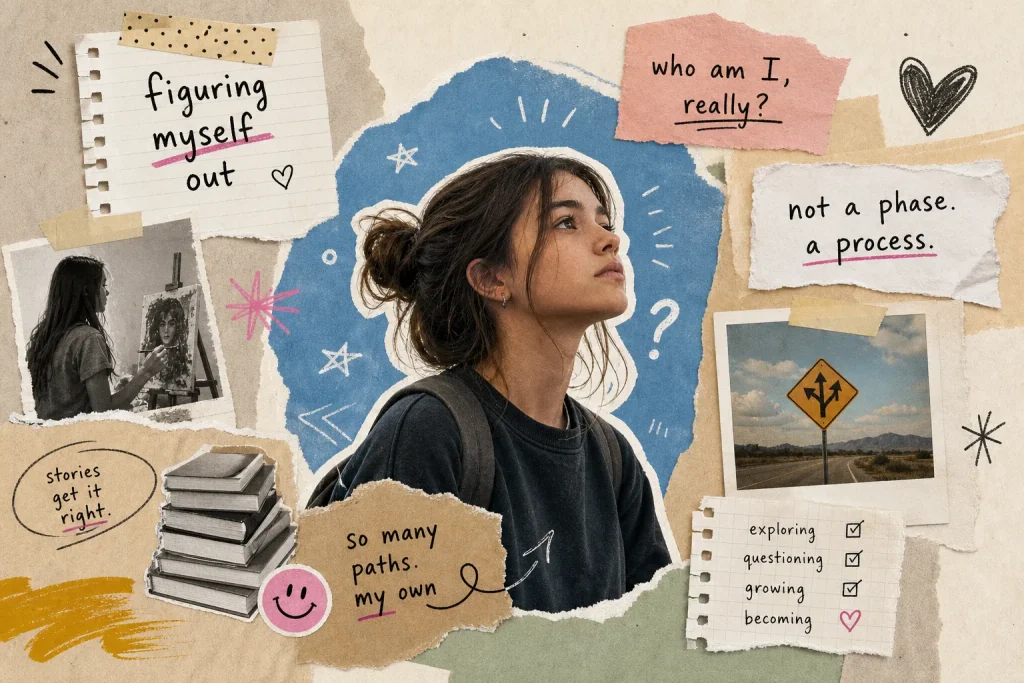
Teen identity development is a documented psychological process, not a phase adults endure until teenagers become reasonable again. Erikson mapped it. Marcia operationalized it. Neuroscientists have since traced adolescent self-identity development into the prefrontal cortex and the reward pathways of the brain. And yet, despite decades of research, most teens navigate this terrain without a map they can actually read. What many reach for instead are stories. Ensemble-cast YA fiction, the kind that holds up eight or ten very different teenagers at once and asks who you really are when no one is watching, can be especially resonant for this reason.
This article makes a case for why that instinct is sound. The best YA fiction doesn’t distract teens from identity work; it mirrors that work back to them with more precision than most adults give it credit for. But first, it helps to understand what the research actually says about how identity forms, and why the process is so much stranger than the word “development” implies.
The psychological map every teenager is secretly navigating
Erik Erikson gave adolescence its defining developmental task: build a coherent sense of self across roles, relationships, and future directions. He called this the fifth psychosocial stage, identity versus role confusion, and he placed it squarely in the teenage years. The key word in his framework is “constructed.” Identity isn’t assigned at birth or handed down by parents or institutions. It has to be built, tested, and revised by the person living it. When that construction stalls, what results isn’t a “bad” teenager, it’s a genuinely disoriented one, uncertain about who they are and what they stand for.
James Marcia took Erikson’s insight and made it measurable. He identified two dimensions: exploration and commitment. Cross them, and you get four observable identity statuses. Identity achievement describes teens who’ve genuinely explored alternatives and landed on a committed direction. Moratorium describes active, effortful searching without yet settling on anything. Foreclosure describes commitment without exploration, a teen who has absorbed someone else’s identity wholesale. Diffusion describes a teen who has neither searched nor committed, adrift from the whole question.
Why these statuses aren’t permanent
What modern research adds to Marcia’s model changes the picture significantly: these aren’t permanent slots. Contemporary dual-cycle and three-dimensional models show that adolescents move between statuses as circumstances change. A teen can reach commitment in one domain, say, vocational plans, while sitting in moratorium on values, then have that vocational commitment destabilized by a single experience and cycle back into exploration. This is why a teenager who “seemed to have it all figured out” and then starts questioning everything again isn’t regressing. They’re developing, which is a different thing entirely.
Why turbulence is the system working, not failing
The moratorium state makes adults nervous. A teen who is actively searching but not committed looks, from the outside, like a teen who is lost. But empirically, moratorium is far healthier than diffusion. A teen in moratorium is engaged with the question of who they are; they’re just not done yet. A teen in diffusion isn’t asking the question at all. That distinction matters enormously, and it gets lost when adults treat every period of confusion as a crisis requiring immediate resolution.
Neuroscience gives this some important context. The prefrontal cortex, the region responsible for long-term judgment, impulse control, and complex decision-making, continues maturing through adolescence and into early adulthood. That’s not a flaw in the adolescent brain; it’s a feature. At least one longitudinal line of research has found that delayed prefrontal maturation is linked to stronger in-depth identity exploration. Neural plasticity creates the conditions for trying on different identities. The adolescent brain’s heightened sensitivity to social feedback and immediate reward isn’t a bug to be managed; it’s what makes exploration possible in the first place. The teenage brain is built to search.
What this means for parents and educators
This reframe has direct implications for how adults respond to adolescent searching. The goal isn’t to end the search faster. Premature commitment, what Marcia called foreclosure, is associated with worse long-term identity outcomes than letting the moratorium run its course. An active teen self-concept, one that questions and revises, is healthier than one that settles too quickly. The goal is to create the conditions in which searching is safe.
How peer dynamics shape teen identity development
The research is consistent on this point: peer relationships become more influential than parental support during adolescence, not because parents stop mattering, but because peers provide something parents structurally cannot. The peer group is the audience for identity performance. How peers respond to a teen’s emerging self-presentation shapes which identities feel viable and which don’t survive contact with the social environment. Parents provide the secure base; peers provide the laboratory.
Family still plays a critical role, though, a specific one. Studies show that parental psychological control, the kind that pressures teens toward particular identities, makes teens more susceptible to peer influence, not less. Parental warmth and autonomy support, the kind that says “I’m here while you figure this out”, is associated with better identity outcomes and lower vulnerability to peer pressure. When the home environment is cold or controlling, the peer laboratory becomes more volatile. The two systems work in tandem, and the quality of one shapes the stakes of the other.
Social media operates as an amplifier within this system rather than a separate force. It accelerates feedback loops that already exist. Anonymous accounts and viral moments can compress into a single public incident what might otherwise have unfolded over months of gradual social adjustment. Research indicates that complete restriction isn’t the only option; effects depend heavily on use and context. What teens need is scaffolding: the capacity to interpret what happens to them online without losing their footing. That scaffolding rarely arrives as a lecture. It more often arrives as a story.
What eight very different teenagers in one room can teach us
This is where Accidental Tribes by C.S. Pascoal (Prospera Books) becomes worth discussing directly. The novel’s premise places eight defiant teenagers in an isolated classroom called Solitaria, cut off from the social ecosystem that usually mediates identity work. No usual peer groups. No social media access. No institutional roles to hide behind. Each character is left with the identity questions they’ve been successfully deferring: Who am I when no one is watching? What do I actually believe when there’s no audience for the performance?
This setup puts pressure on adolescent self-identity in the same way that research describes crisis accelerating identity exploration. Where most YA novels follow a single protagonist through a single arc, Accidental Tribes holds eight distinct teenagers simultaneously, each representing a different relationship to exploration and commitment. Some characters arrive with the brittle confidence of foreclosure, committed without ever having questioned. Others are in full moratorium, visibly searching. Others have slipped into diffusion and don’t yet know it. Because the novel runs all eight tracks at once, almost any teen reading it will find their own status reflected somewhere in the ensemble, without being told what to feel about it.
The mystery engine matters here, too. An unsolved death, stolen funds, and institutional deception create the exact conditions under which identity commitments become meaningful: when the comfortable answer is also the wrong one. Identity commitment formed after genuine exploration, especially under moral pressure, tends to be more durable than commitment formed in comfort. Accidental Tribes doesn’t ask its characters to discover who they are in peace. It puts their values, loyalties, and self-concepts under actual strain, which is the condition under which teen identity development becomes real rather than theoretical.
Belonging, moral choice, and what fiction does that textbooks can’t
Belonging shows up reliably in the literature as a precondition for confident identity exploration. Teens who feel genuinely connected to a peer group explore more confidently and commit more authentically. The inverse is equally documented: teens who feel structurally excluded often retreat into diffusion or false foreclosure, adopting identities handed to them by the only group that will accept them. Fiction that depicts outsider characters finding unexpected belonging isn’t wish fulfillment. It models the exact social conditions that research identifies as necessary for healthy adolescent identity formation.
There’s also a concept drawn from narrative identity theory called identity rehearsal: the process by which teens use hypothetical or narrative scenarios to test identity commitments before real-world consequences attach. A teen reading about a character who chooses honesty at personal cost isn’t just tracking a plot. They’re rehearsing the internal logic of that choice, asking whether it aligns with their own emerging values. Fiction that refuses easy moral answers creates richer rehearsal space than fiction where the right choice is obvious by chapter three. The layered institutional deception and competing loyalties in Accidental Tribes are not narrative complications; they are the developmental work, placed inside a story where teens can test themselves against it without consequence.
What parents and educators can actually do with this knowledge
The evidence-based interventions with the strongest research support are school-based, reflective, and structured around exploration rather than prescription. The Identity Project, an eight-session classroom intervention focused on ethnic-racial identity exploration, has shown measurable gains in self-esteem, depressive symptoms, identity clarity, and academic outcomes, though researchers note that overall intervention effects vary by design and domain. Brief values-affirmation writing exercises have shown stable or improved self-esteem over the course of a school year. School environments that integrate restorative practices, cross-group collaboration, clubs, and opportunities for creative expression show links to healthier adolescent identity trajectories, though the strength of evidence varies by context.
Three practices the research keeps returning to
For parenting specifically, the research points repeatedly to the same behaviors: validating a teen’s experience without immediately trying to fix it, making space for exploration without rushing toward commitment, and maintaining warmth even when the teen’s chosen direction is uncomfortable for the parent. Foreclosure by parental pressure is a documented outcome, and it tends to produce teens who look stable until something destabilizes the borrowed identity they never actually chose.
The most effective thing a parent or educator can do with a book like Accidental Tribes is read it alongside the teen and ask questions rather than deliver interpretations. Questions anchored in character choices, “Why do you think she didn’t tell anyone?” or “What would you have done in that moment?”, create identity rehearsal in conversation rather than performance anxiety in the classroom. Discussion guides built around ensemble YA fiction can connect naturally to digital citizenship and social-emotional learning, because the story has already done the framing work. The curriculum doesn’t need to announce itself. The best fiction never does.
The territory teens are already navigating
Teen identity development isn’t a problem to be solved before adulthood arrives. It’s the defining work of adolescence, messy, cyclical, and social by design. The research doesn’t describe a clean linear march from confusion to clarity. It describes a process that doubles back, stalls, accelerates under pressure, and requires other people as mirrors and laboratories at every stage. Teens don’t need a roadmap handed to them by adults who have already resolved the same questions. They need stories that prove others have survived the same territory.
The best YA fiction does exactly that, not by simplifying the journey, but by populating it with characters who look, sound, and struggle like the reader does. Accidental Tribes takes that seriously: eight teenagers, one crucible, no easy answers, and an illustrated format that makes the ensemble accessible to readers who’ve never thought of themselves as readers. If you’re an educator, parent, or teen looking for a book that meets this moment honestly, one that takes the research seriously without announcing it, this is that book. It launches September 22, 2026, and free first chapters and pre-orders are available now.