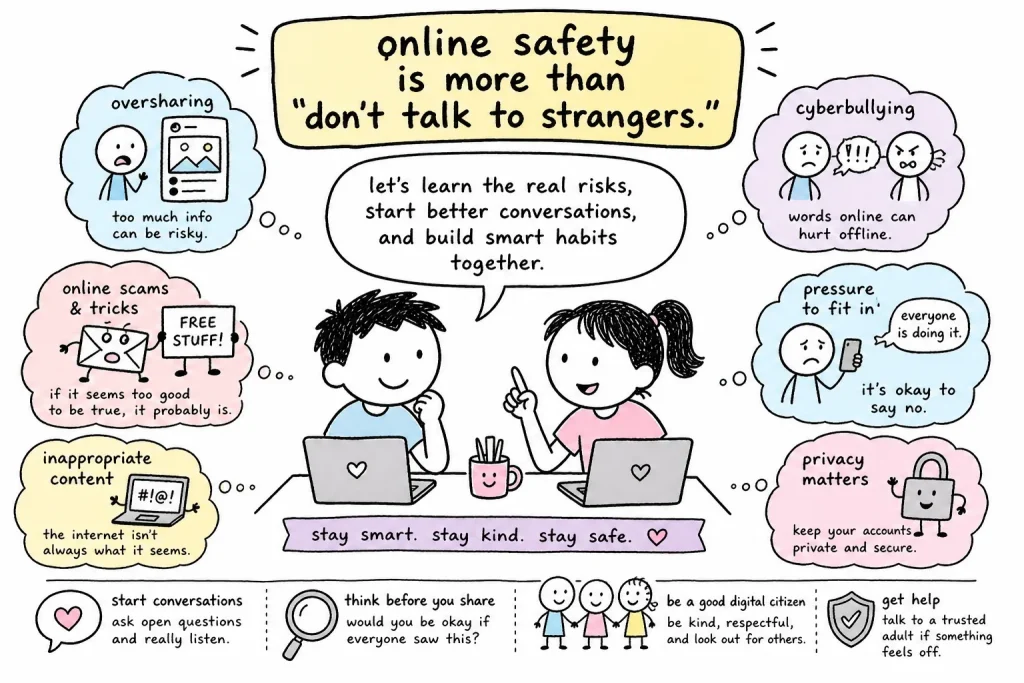
The gap between the risks that exist and the conversations we’re having is significant. Parents and teachers mean well, but the scripts haven’t caught up with the environment. Meanwhile, a new illustrated YA mystery from Prospera Books, Accidental Tribes by C.S. Pascoal, takes a different approach from most safety curricula: it puts eight real-feeling teenagers inside these exact digital traps and lets readers watch what happens in real time. More on that later.
This guide covers the actual risks in play right now, how to talk about them without triggering a shutdown, and what lessons and tools parents and educators can put to work this week. No jargon, no 40-step overhaul. Just what works for online safety for middle schoolers.
Middle school online safety: The digital threats tweens actually face in 2026
The first step is understanding what middle schoolers are actually navigating online. Some adults are still imagining a 2015 internet when they think about their kids’ online lives. The risks have evolved, and so has the scale.
AI-generated harassment and anonymous account abuse
AI tools have made it possible for classmates to take an ordinary photo of a peer and generate a fake explicit image in minutes. According to 2025 and 2026 reports, including data from the Internet Watch Foundation, which found girls represented 97% of subjects in one AI-generated child sexual abuse dataset, girls make up the vast majority of targets in these cases, and the images circulate quickly through school social networks before adults are even aware something has happened. This isn’t a theoretical risk: it’s embedded in middle school social life, spreading through group chats, gaming platforms, and shared accounts. Nearly a third of children in 2026 reported unwanted contact from strangers online, and AI-powered impersonation has made that contact harder to detect and easier to scale.
The scale of cyberbullying and online enticement
The Cyberbullying Research Center’s 2025 survey found 58% lifetime cyberbullying victimization among U.S. middle and high school students, with 33% reporting it happened in the past 30 days. The UN reports that one in five young people globally say cyberbullying caused them to skip school. On the enticement side, NCMEC received more than 186,000 reports of online enticement in 2023 alone, a number that tripled in just two years. Grooming often starts through gaming platforms and shared-interest communities, not direct messaging, which means the entry points adults typically watch aren’t the ones kids are being approached through.
Why today’s risks look different from five years ago
Social media platforms have become more sophisticated, not safer. Algorithmic amplification means that a single incident can reach hundreds of peers before it would have spread at all under older platform architectures. The combination of anonymous accounts, AI-generated content, and algorithmic reach makes a single harmful act far more damaging than it was five years ago. Middle schoolers are operating in the thickest part of this environment without the cognitive tools to navigate it, and most safety curricula haven’t been updated to reflect what that environment actually looks like.
Middle school online safety: Talking to teens without shutting them down
The most powerful safety tool parents and educators have is the conversation itself. Most of those conversations fail not because the information is wrong but because the approach signals surveillance rather than support.
Warning signs worth knowing
Behavioral shifts are often the first indicator that something is wrong online. Watch for sudden withdrawal from devices after heavy use, heightened anxiety around notifications, hiding screens, or becoming secretive about who they’re talking to. Other signals include using sexual language that feels out of place, keeping unexplained gifts or money, or becoming unusually tired or withdrawn from school and activities. When you notice these signs, the supportive response is to name what you’re observing calmly and open a door, not close one by demanding access to their phone.
Conversation starters that actually work
Scenario-based openers work better than interrogation-style questions because they frame the conversation as an information exchange rather than an accusation. Try: “I read something about AI being used to fake photos of kids at school. Has anything like that ever come up for you?” Or: “What do you like about the apps you use most?” For classroom settings, discussion prompts that create psychological safety before asking students to share personal experiences are more effective. Start with a fictional scenario or a news story, let students react to that first, then invite personal reflection.
Trust as the real safety net
Students who believe they can tell a trusted adult when something goes wrong online are the ones who actually report it. That’s the outcome every cyber safety conversation for tweens should be designed to produce. The goal isn’t to frighten or restrict; it’s to make the adult in the room someone safe to come to. If a teen’s experience of telling you about an online problem is that you panic, punish, or immediately confiscate their phone, they won’t tell you the next time. The first response to a disclosure should almost always be: “I’m glad you told me. Let’s figure this out together.”
Core topics every middle school online safety curriculum should cover
Educators and parents don’t need an exhaustive list of every possible digital risk. They need a manageable scope of what to teach and roughly when to teach it.
Privacy, passwords, and what “personal information” really means for tweens
For grades 5 and 6, the key learning objectives center on basic habits: identifying what counts as personal information, understanding what not to share, and knowing who to tell when something feels wrong. By grades 7 through 9, students are ready to evaluate privacy settings critically, understand how data collection works, and think about what their digital footprint looks like to outsiders. Information that feels harmless in isolation, a school name or sports team, for example, can be combined with other details to create a genuine safety risk. That concept is worth teaching explicitly in any internet safety curriculum for grades 6, 8, because most tweens don’t see it until it’s demonstrated.
Digital footprint and the permanence problem
Middle schoolers understand consequence better when it’s framed in terms of what they care about. A photo posted today can be screenshotted, shared out of context, and surfaced years from now in situations the student hasn’t imagined yet. Lesson objectives here should build the habit of pausing before posting and understanding how content travels once it leaves a private account. The permanence problem also connects directly to the AI-generated content risk: once an image exists, it can be manipulated and redistributed in ways that are nearly impossible to reverse.
Middle school cyberbullying prevention and the bystander role
Most cyberbullying curricula focus on victims and perpetrators, but the bystander angle gives more students a point of agency. Learning objectives should cover recognizing harmful behavior, understanding that forwarding content counts as participating, and knowing how to report and preserve evidence. Schools operating under CIPA-required internet safety policies already need this material in formal curriculum; connecting the lesson to that framework gives educators administrative support for the conversation. Research on bystander education consistently shows it is among the more effective approaches to shifting the social norm around forwarding and pile-ons, giving students concrete skills rather than abstract warnings.
Online safety activities for students: Lessons and tools that make digital safety stick
Educators don’t need a comprehensive directory of every available resource. They need to know where to start, why it works, and what makes these tools more effective than a standard slide deck or handout.
The free internet safety curriculum resources worth your time
Common Sense Education’s 6, 8 scope and sequence is the broadest curriculum backbone available and covers cyberbullying, privacy, digital footprint, and more, though some features require a free educator account to access. The CSNP five-day module for grades 6, 8 comes with editable slide decks, handouts, and pacing guides for a structured multi-day unit. NetSmartz, from the National Center for Missing and Exploited Children, provides a presentation and teacher guide that works for a single-session format. Be Internet Awesome offers interactive Google Slides built with Pear Deck integration and requires no student login or personal information. Many of these resources are completely free, while a few require a free educator account to unlock full materials.
Games and simulations that hold middle schooler attention
Google’s Interland is one of the most frequently used gamified entry points for digital citizenship in middle school: students practice safety, kindness, and digital literacy through gameplay rather than lecture. Social Media Test Drive puts students into realistic online scenarios where they make decisions and see consequences play out. Nearpod and Pear Deck work well for live classroom delivery because they build quizzes and discussion into the lesson flow in real time. The reason these formats outperform videos and handouts is straightforward: students retain more when they’re making choices inside a simulation than when they’re passively receiving information from the front of the room.
Why fiction works when direct lessons don’t
For many middle schoolers, a safety lesson reads as “adult telling me what to do.” A good story reads as “this is about someone like me.” That difference in reception is real, educators who use story-based tools in digital citizenship units see it consistently, and it matters for how teens process and retain safety information.
What story does that instruction can’t
Narrative activates empathy and imagination in ways that risk statistics don’t. When a teen watches a character navigate viral humiliation, AI-generated fake content, or an anonymous account targeting campaign inside a story, they process the risk personally without feeling surveilled or lectured. That processing makes them more likely to recognize the situation in real life, remember what they saw, and tell someone when it happens to them or a friend. The emotional distance that fiction provides is actually a feature: it lets teens engage with threatening material without triggering the defensiveness that a direct safety lesson often produces.
Accidental Tribes as a classroom and family discussion tool
Accidental Tribes by C.S. Pascoal, published by Prospera Books and launching September 22, 2026, puts eight defiant teenagers in a forgotten classroom called Solitaria, where they uncover an unsolved death, stolen funds, and institutional lies. Woven throughout the plot are AI misuse, hacked systems, viral humiliation, anonymous accounts, and social media addiction, playing out as story, not warning labels. The book was reviewed by a Teen Advance Reader Council before publication and carries classroom resources from the publisher, which means educators can use it without extensive extra prep work. It has received attention from Midwest Book Review and The Children’s Book Review. For parents looking for a way into these conversations that doesn’t feel forced, this is a book many teens will choose to finish.
Discussion angles that connect the book to real safety conversations
These questions work for home or classroom, and they can open a conversation even before an adult has finished the book. First: when you see something shared online that you can’t verify is real, what’s your responsibility before you forward it? Second: does being anonymous online actually protect you, or does it just change what you feel comfortable doing? Third: what do you do when the adults who are supposed to help are part of the problem? These questions meet students where the book leaves them and open exactly the conversations that direct internet safety lessons rarely reach.
A practical starting point for home and school
Nobody needs a 40-step safety overhaul. What parents and educators need is one manageable entry point they can actually execute this week.
Parental tips for kids’ online safety, starting this week
Start with one open-ended conversation using one of the scenario-based openers from above. Then sit down together and review the privacy settings on the two or three platforms your child uses most, not as a check-up, but as a shared activity. Finally, establish one clear family agreement about what happens when something uncomfortable occurs online: the first response is not punishment. These three actions build a foundation. They don’t require any expertise, and they signal to your child that you’re someone they can bring problems to.
What teachers can do before the next class
Pull up one of the free curriculum resources identified above and find the single lesson that fits your next available instructional window. You don’t need to plan a full unit today. If you’re working on a digital citizenship or social-emotional learning unit, consider adding Accidental Tribes as a fiction component: the publisher’s classroom guide handles the discussion facilitation planning, so the teacher’s job is simply to introduce the book and let the story do the work it’s designed to do.
The adults who show up make the difference
Middle school online safety in 2026 is a real, current, serious issue. The threats have outpaced the conversations, and they’ve certainly outpaced most of the curricula still in use. The good news is that parents and educators don’t have to figure this out from scratch. The resources exist, many are free, and they work.
For students who tune out direct instruction, story-based tools like Accidental Tribes offer a way in that doesn’t feel like a lesson. A teen who sees eight characters navigate viral humiliation, fake images and pile-ons, and social pressure in a novel is better prepared to recognize those situations and respond to them than a teen who sat through a slide deck on the same topics.
Pick one thing from this guide and do it this week, one conversation, one lesson, one book. The students dealing with anonymous accounts and social media pressure right now don’t need adults who have all the answers. They need adults who show up and make it safe to talk.