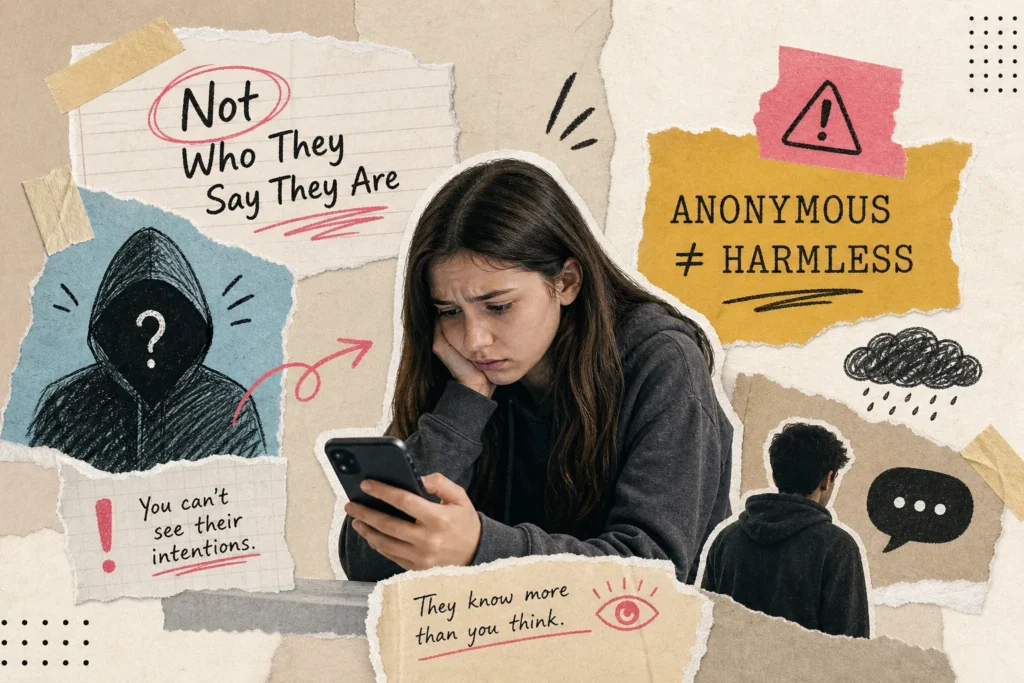
The danger of anonymous accounts for teens is real, and it often starts with a moment you almost miss.
You pick up your teenager’s phone to silence an alarm and notice an app you don’t recognize. No profile
photo. No real name. Just a handle that looks like a random string of letters and a feed full of strangers
posting things you’d never expect a fourteen-year-old to see. You set the phone down, and the feeling
stays with you.
That discomfort is worth paying attention to. Anonymous accounts aren’t just quirky corners of the internet where teens blow off steam. They’re environments where harassment, blackmail, and identity-
based targeting happen with almost no paper trail to follow. The platforms vary: Yik Yak uses location, Whisper lets users post without any identity, NGL runs anonymous Q&A threads, Reddit operates largely
on pseudonymous usernames, and Omegle ran anonymous one-on-one video chats until it shut down in
2023 under the weight of safety concerns. But the risks run through all of them in similar ways.
This article isn’t meant to scare you. It’s meant to equip you. By the end, you’ll know what the research
actually says about these platforms, what warning signs to watch for, which tools to set up, and exactly
what to do if something has already gone wrong.
Why anonymous apps pull teens in so hard
Think about what your teenager’s social media life actually looks like. Every Instagram post is evaluated.
Every TikTok is a performance. Every comment section is a place where peers can respond in real time.
That kind of constant visibility is genuinely exhausting, and anonymous platforms offer something that
feels like relief: you can say what you actually think without your face or your name attached to it.
The psychological draw is real. Teens use these spaces to experiment with identity, to ask questions
about sexuality or mental health they’re not ready to ask out loud, to vent frustration that would cause
drama if it came from their real account. For many teens, anonymity feels like freedom, and that’s exactly
why it’s so appealing and so risky at the same time.
The problem is also wider than most parents realize. Pew’s 2026 data shows Reddit at around 14% of
teen usage, and anonymous messaging behavior spreads well beyond dedicated anonymous apps.
Anonymous social networks, anonymous messaging apps, and anonymous posting features are built into
platforms teens already use daily. Snapchat, used daily by 57% of teens for messaging, isn’t fully
anonymous but creates conditions where disappearing content can make dangerous exchanges feel
lower-stakes. Anonymity isn’t one app. It’s a feature woven into how teens use the internet broadly.
Why anonymous accounts are dangerous for teens: the
documented harms
Anonymous cyberbullying hits differently than harassment from a known source. A mixed-methods
systematic review found that adolescents specifically described anonymous digital aggression as more
humiliating and threatening than other forms of bullying, precisely because they couldn’t identify who was
behind it. When you can’t name the source, you can’t contextualize it, defend against it, or confront it.
Australia’s eSafety Commissioner identifies anonymous, fake, and impersonator accounts as direct
contributors to the cyberbullying complaints they receive and track. The documented victim impact
includes lowered self-esteem, anxiety, school truancy, and in severe cases, suicidal ideation. These aren’t
hypothetical harms. They’re outcomes tied to specific social media conditions that researchers have
studied across thousands of adolescent cases.
Then there are the regulatory actions that confirm the danger anonymous accounts pose to teens isn’t
abstract. In July 2024, the FTC and the Los Angeles County District Attorney filed a complaint against
NGL Labs, the company behind the anonymous messaging app “NGL: ask me anything.” The allegations
included sending fake messages that appeared to come from real people, falsely claiming AI-moderated
safety features, and knowingly marketing the app to minors. The resulting order included a $4.5 million
consumer refund settlement and became the first FTC-mandated age ban on an anonymous messaging
service for users under 18.
A separate enforcement action against Sendit followed in September 2025, with similar allegations:
COPPA violations, fake messages, and subscription traps built around anonymous-message reveals. Two
apps, two regulatory crackdowns, one consistent pattern of harm.
The psychological toll most parents don’t see coming
The peer-reviewed evidence on anonymous cyberbullying is consistent and sobering. Meta-analyses link cyberbullying victimization to a consistent cluster of outcomes: depression, anxiety, social withdrawal,
lower self-esteem, school absenteeism, and academic decline. One longitudinal study found that
cybervictims were significantly more likely to report depressive symptoms and social anxiety at follow-up,
even after adjusting for baseline factors.
What makes the anonymous version distinctly harder to process is that teens can’t do the normal
cognitive work of conflict resolution. With a known peer, you can at least try to understand the context, the
motive, or the relationship. With an anonymous attacker, you don’t know if it’s one person or twenty, a
classmate or a stranger, someone targeting you specifically or just throwing cruelty at random.
Longitudinal studies confirm that this ambiguity reduces coping ability and increases the sense of
helplessness.
Sometimes the conversation between a parent and a teenager about these risks doesn’t land the way it’s
meant to, not because the parent is doing something wrong, but because lectures about danger don’t
always reach teens the way stories do. Accidental Tribes by C.S. Pascoal (Prospera Books) offers a
different kind of entry point. The novel centers on eight teenagers navigating a mystery involving AI
misuse, viral humiliation, hacked systems, and the specific cruelty of anonymous targeting. It doesn’t
preach. It immerses readers in the consequences through characters who feel like people they actually
know. For parents looking to open a conversation without it turning into a safety lecture, handing a teen
this book first can be the soft opening that makes the real conversation possible.
Warning signs: anonymous accounts and teen risk
The behavioral shifts worth watching for tend to cluster around devices. A teen who is visibly upset after
checking their phone but won’t say why, who has pulled away from friends they used to talk about openly,
or who seems anxious around notifications is showing you something, even if they can’t articulate it yet.
The opposite pattern matters too: a teen who suddenly refuses to look at a device they previously couldn’t
put down may be avoiding something painful.
Unexplained apps are a direct signal worth investigating calmly. Apps with blank icons, apps installed
under unfamiliar names, or a second account your teen hasn’t mentioned all fall into this category.
Anonymous usernames and anonymous profiles are easy to create and hard to spot. None of these are
proof that something is wrong, but all of them are worth a conversation.
It’s also worth acknowledging something parents sometimes resist: teens can be both targets and
aggressors, sometimes in the same week. Signs that a teen may be causing harm include protectiveness
over device screens around adults, dismissiveness about “just joking around” online, and secretive
conversations about specific classmates. If you notice these, the goal isn’t punishment. It’s a different
kind of conversation, one that asks what’s actually going on in your teen’s social world and why anonymity
feels useful to them.
Practical steps to protect your teen before something goes wrong
iPhone and iPad controls
Device-level controls are the starting point. On iPhone and iPad, go to Settings, then Family, then your
child’s name, then Content and Privacy Restrictions. Turn on restrictions using your Screen Time
passcode so your teen can’t override your settings. From there, you can set age limits for apps, media,
and web content. Apple’s Family Sharing lets you manage all of this from your own device without
needing physical access to theirs.
Android controls
On Android, open the Family Link app, select your child, and navigate to Controls, then Google Play. You
can manage app approvals and content filters across Chrome, YouTube, Play, and Search from there. On
the child’s device, parental controls in the Play Store can also be locked with a PIN.
Platform settings and monitoring tools
Beyond device controls, platform-specific settings matter a lot. On Instagram, privacy settings can limit
who can contact your teen and restrict search visibility. Reddit’s anonymous browsing doesn’t actually
hide everything, and it’s worth explaining that to your teen directly. Snapchat’s Map feature should be off
by default unless there’s a clear reason to use it.
Monitoring tools add another layer. Bark monitors more than thirty platforms and can alert you when a
child creates a secondary account or when account-verification emails show up. Qustodio can track
messages across WhatsApp, Instagram, and similar apps, sending alerts for concerning content. One
critical limitation: all of these controls fail the moment your teen uses mobile data, public Wi-Fi, or a
friend’s device. Device controls must be paired with account supervision and ongoing conversation to
actually work.
What to do when harm has already happened
Screenshot everything first, before you report anything. Platforms can remove content quickly, sometimes
before you realize you need documentation. Capture full conversation threads, anonymous usernames,
timestamps, and any account details visible on screen. Those screenshots may matter if you later need to
involve a school, law enforcement, or a legal process.
Report within the app using whatever harassment or abuse flagging is available. If in-app reporting feels
inadequate, escalate directly to the platform’s safety team. For cases involving sexual content, grooming,
or criminal threats, the National Center for Missing and Exploited Children’s CyberTipline is the right place
to file a report. Local law enforcement is also an option: anonymity on the harasser’s end does not prevent
law enforcement from requesting account data through proper legal channels.
When you talk to your teen afterward, don’t lead with “why didn’t you tell me?” Lead with “I’m glad I know.
What do you need right now?” Validate that being targeted by someone anonymous is specifically
disorienting. Name that experience for them explicitly, because teens who’ve been through anonymous
harassment often feel a kind of groundlessness that’s hard to describe. Giving that feeling a name helps.
If an app deceived your child or charged unauthorized fees, the FTC’s complaint portal is a real option.
Filing a report at ftc.gov/complaint is directly relevant to cases like NGL and Sendit, where consumers
were charged without clear consent. Have the app name, approximate dates, and any payment records
ready before you file.
You don’t have to understand every app to show up for your teen
The internet isn’t going anywhere, and neither are anonymous apps. New ones will appear after every
enforcement action, every shutdown, every news cycle. The goal for parents isn’t to build an impenetrable
wall. It’s to become a safer option than a faceless stranger on Whisper. Teens who feel genuinely heard at
home are more likely to bring problems to their parents before those problems escalate.
The harms are documented and measurable: harassment that hits harder because the source is unknown,
regulatory actions against apps that knowingly targeted minors, psychological research linking
anonymous cyberbullying to depression, anxiety, and school avoidance. Staying engaged and using
layered protections reduces the danger anonymous accounts pose to your teen. Parents who approach
these conversations with curiosity rather than surveillance make a measurable difference.
If you’re looking for a way to start that conversation without it feeling like a safety lecture, Accidental
Tribes launches September 22, 2026. It’s a fast-paced illustrated mystery that puts eight real-feeling
teenagers inside exactly the kind of digital chaos this article describes. Sometimes a story reaches where
a parent’s words can’t. And sometimes that’s the most useful thing you can offer. You don’t have to
understand every app. You just have to keep asking the right questions.
Ready to read Accidental Tribes?