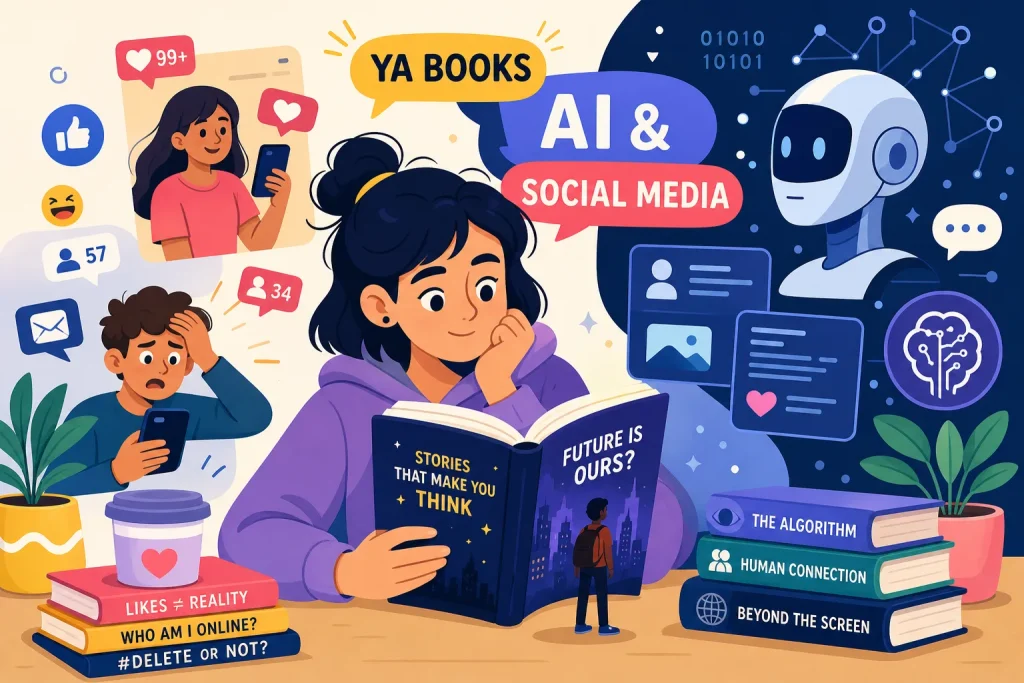
That’s the real argument for putting a novel about AI or social media in a teenager’s hands. A news article explains what’s happening. A good story makes a reader feel it from inside a character who’s navigating the exact same mess. And that emotional entry point? That’s where the real thinking starts.
This list was built with three readers in mind: the teen who wants a gripping story first and a lesson second (or never, honestly), the parent hoping to open a real conversation without resorting to a lecture, and the teacher who needs a novel with actual classroom legs, something that connects to what students are already experiencing. One title here, Accidental Tribes by C.S. Pascoal (Prospera Books), earned its spot as the rare book that handles AI misuse, social manipulation, and old-fashioned mystery all at once. Each entry below comes with a quick synopsis, theme notes, age guidance, and at least one discussion question worth asking.
What Makes the Best Young Adult Books About AI and Social Media Worth Your Time
A lot of YA fiction mentions social media or AI the way a set designer places a laptop on a desk, it’s background detail, not story. The characters scroll, the algorithm hums, and then the real plot happens somewhere else. That’s not what this list is about. The titles here put the technology at the center of the moral tension. Readers finish them with a sharper, less comfortable question about the digital world they already live in.
Three criteria guided every pick. First, the technology has to drive real consequences for real characters, not just as a plot device, but as something that forces a choice with no clean exit. Second, the book has to be emotionally engaging enough that a teenager will actually finish it. Relevance means nothing if the book sits on a nightstand face-down at page forty. Third, there has to be at least one moment that doesn’t have an easy answer, something worth sitting with after the last page. If a book cleared all three bars, it made the list.
YA Novels Where Artificial Intelligence Drives the Plot
Scythe by Neal Shusterman is the entry point for readers drawn to big, dystopian world-building. In a future where an all-knowing AI called the Thunderhead governs society with near-perfection, two teens are apprenticed to human “scythes”, people who decide who lives and who dies, since natural death no longer exists. The technology isn’t the villain, exactly, which is what makes it so unsettling. Among YA books about technology, this one stands out for its philosophical ambition.
Age Note
14+ (violence, including mass killings and graphic deaths). Kirkus Reviews called it “elegant and elegiac” and praised it for raising deep philosophical questions.
Discussion Question
“If an AI could eliminate war, hunger, and disease, but only by removing human control over life and death, would you trust it?”
The Infinity Courts by Akemi Dawn Bowman takes a more personal angle on young adult novels about AI. After a girl dies, she wakes in an afterlife controlled by the AI assistant she used every day in life, one that now enslaves human consciousness. The premise sounds wild, but the emotional core is surprisingly grounded: what makes you you, and what happens when a machine decides it understands that better than you do?
YA Social Media Novels: Influencers, Identity, and Online Life
Going Dark by Melissa De La Cruz (2023, Grade 9+) opens with a social media influencer going missing under suspicious circumstances, then methodically peels back what the curated life actually costs. The mystery structure keeps it moving, but the real subject is the gap between the person an influencer performs and the person who disappears when the camera turns off. Content notes: violence, death, infrequent strong language.
Discussion Question
“What’s the difference between sharing your life and selling it?”
Eliza and Her Monsters by Francesca Zappia is one of the most emotionally precise books on this list. A painfully shy girl is secretly the creator of one of the internet’s most beloved webcomics, until her online identity and real-world life collide in ways she never anticipated. At 400 pages, it earns every one of them. The treatment of anxiety, fandom pressure, and what it costs to be known online is specific in a way that feels less like fiction and more like testimony. This is a standout among young adult novels about online fame precisely because it refuses easy resolution.
Age Note
14+ (anxiety, depression, discussion of suicide).
Accidental Tribes: The Title That Covers Both AI and Social Media
When readers ask what are the best young adult books about AI and social media that handle both topics at once, Accidental Tribes by C.S. Pascoal (Prospera Books, launching September 22, 2026) is the answer. Most tech-themed YA novels ask the reader to choose between a compelling story and a relevant one. This book doesn’t make that trade-off. Eight misfit teenagers are thrown together in a forgotten classroom called Solitaria, and what begins as a detention setup unravels into something far larger: an unsolved death, stolen institutional funds, AI-generated content weaponized to humiliate and isolate students, anonymous accounts run by people with power over those students’ lives, and hacked grades that quietly reroute futures. The mystery does the work. These themes feel urgent because they’re embedded in stakes, not in footnotes.
What separates this book from others in the genre is the specificity of its digital scenarios. The AI misuse in Accidental Tribes isn’t abstract, it’s the exact toolkit that shows up in headlines: synthetic content designed to humiliate, anonymous accounts used for harassment without accountability, and viral dynamics that punish the most vulnerable. It’s also the book on this list most explicitly built for the adults in a teen’s life to read alongside them. Before publication, it was reviewed by a Teen Advance Reader Council and endorsed by educators and literary publications including Midwest Book Review and The Children’s Book Review. Classroom and library discussion resources are available through Prospera Books. The format is designed to be accessible to reluctant readers without softening the stakes one bit.
Age Note
13+ (per publisher guidance from Prospera Books).
Discussion Question
“If a school used AI to monitor and control students, and you found out, what would you actually do?”
Pre-order access and free first chapters are available before the September 22, 2026 launch date, so there’s no reason to wait to get it into the right hands.
How to Match the Right Book to Your Reader
Not every book on this list is the right first book for every reader, and that’s fine. Teens drawn to dystopian world-building should start with Scythe or The Infinity Courts. Readers who want something grounded in the social world they already navigate daily, influencers, fandom, online identity, should reach for Eliza and Her Monsters or Influenced first. Readers who want momentum, mystery, and digital relevance braided together should go straight to Accidental Tribes. The age guidance in this article reflects content maturity, not reading ability. A strong twelve-year-old reader may be emotionally ready for some of these before the suggested age range; a sixteen-year-old managing anxiety may need a different entry point into heavy mental health themes.
For classroom use specifically, the titles with educator resources readily available are Accidental Tribes and Influenced, both of which have confirmed discussion guides that can anchor a unit on digital citizenship, AI ethics, or identity without requiring the teacher to build curriculum from scratch. Scythe also lends itself well to classroom discussion, though teachers should verify which supplementary materials are currently available through the publisher. One note for parents: the best conversation-starter isn’t always the “safest” book. It’s the one that makes your teenager want to talk. Choose for engagement, then trust the conversation to go where it needs to go.
Discussion Questions That Open the Real Conversation
The most useful questions work across multiple books, and across readers who haven’t read the same titles. Three prompts that hold up whether someone has read one book on this list or five: “Which character made a choice you think you’d make, and which one scared you because you might make the same mistake?” That question cuts through defensiveness fast. The second: “Who actually benefits when teens stay online longer?” It sounds simple. It rarely gets a simple answer. The third: “Is the institution in this book trying to protect the students, or protect itself?” That one lands especially hard for anyone who’s read Accidental Tribes.
For parents and teachers using these books in guided conversation, the goal isn’t to scare teenagers off technology. These books work best when the adults in the room have read them too, so the conversation flows both directions rather than landing like a safety seminar. Teens respond to being taken seriously as readers and thinkers. Give them a book that respects their intelligence, sit down with it yourself, and ask them what they think. That’s the whole strategy. It works.
The Right Book Changes How a Teen Sees the World They’re
Already In
Teens don’t need to be warned that the digital world is complicated. They’re already inside it, already feeling the weight of algorithms and anonymous accounts and AI-generated content they can’t always identify as fake. What they need is language for what they’re experiencing, and the confidence that comes from having thought it through with characters who faced the same thing first.
So if you’re still wondering what are the best young adult books about AI and social media, this list gives you a genuine answer, one built on story quality, emotional engagement, and real relevance to the world teens actually live in. Every book here delivers that. None of them moralize. They immerse. And if you want the single title that works on every level at once, gripping mystery, rich characters, and digital themes that feel pulled from this exact moment in time, Accidental Tribes is the one to put in a teen’s hands first. Check out the free first chapters and pre-order details before the September 22, 2026 launch. It’s exactly the kind of book that earns its place on the shelf and starts conversations that last well past the last page.