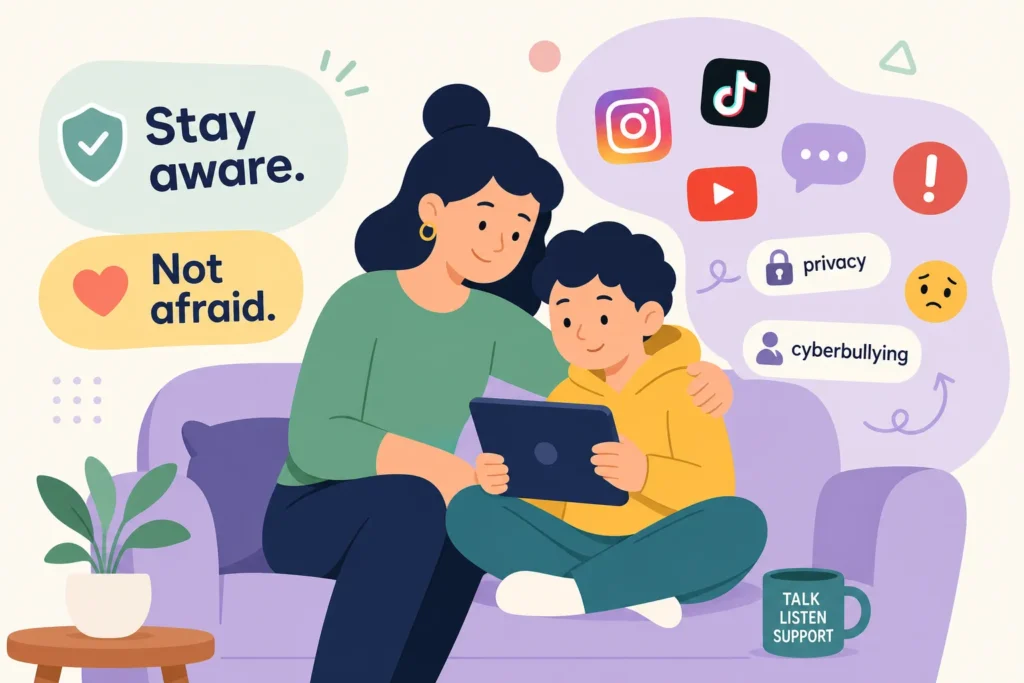
Picture this: you pick up your kid’s phone to check the weather, and you’re suddenly staring at six apps you’ve never opened, three notification badges from platforms you’ve only vaguely heard of, and one icon that looks like a cartoon ghost. You put the phone down and back away slowly. You pretend it didn’t happen.
That moment of quiet panic is more universal than any parenting book will admit, and it’s a completely normal response to the real social media risks for kids that most guides either over-dramatize or gloss over entirely. Being caught off guard doesn’t mean you’re behind. It means you’re living alongside platforms that change faster than any of us can track. The good news: understanding those risks doesn’t require becoming a tech expert. It requires knowing what to look for and which conversations to start. That’s exactly what this guide covers.
The research is clear: heavy social media use is linked to anxiety, depression, and exposure to harmful content among kids and teens. But studies consistently show that informed, engaged parents make a measurable difference in outcomes. And sometimes the sharpest takes on these risks aren’t showing up in parenting manuals. They’re showing up in the fiction teens are actually reading. More on that shortly. For now: here’s your map.
Social media risks for kids: why developing brains are more vulnerable
Before you can address the risks, it helps to understand why kids are so much more vulnerable to them than adults. This isn’t a discipline problem or a character flaw. It’s architecture.
The dopamine loop kids can’t see coming
Social platforms are built on variable-reward mechanics: likes that show up unpredictably, notifications that arrive at random, feeds that never end. These features are designed to keep adults scrolling, but they hit adolescent brains with particular force. The reward pathways in teen brains are still developing, which makes them more reactive to social feedback and more susceptible to compulsive use patterns. A 2026 longitudinal study found that using social media for more than three hours per day was associated with higher depressive and anxiety symptoms later in adolescence. The design of these apps, variable rewards, endless feeds, micro-interactions engineered to maximize engagement, does precisely what it was built to do. Kids just can’t see it happening.
What the numbers actually say about mental health
A 2025 meta-analysis across 24 quantitative studies found a significant positive association between social media risk factors and mental health problems, with an overall correlation of r = 0.2165 across outcomes including depression, anxiety, and suicidal ideation. A 2026 analysis reported that each extra hour of daily device use is linked to a 15% higher chance of moderate-to-severe depression in teens. These numbers are real and worth taking seriously. They’re also not a guarantee, and framing them that way is what lets parents act without spiraling. The goal isn’t fear. It’s informed attention.
Social media risks for kids: what parents need on their radar
There are four main categories of risk that parents need on their radar. Each one affects kids differently depending on age, gender, and which apps they use.
Cyberbullying: who it actually affects
Pew Research found that 46% of U.S. teens ages 13 to 17 have experienced at least one cyberbullying behavior. The breakdown matters: 54% of girls ages 15 to 17 report at least one incident, compared to 44% of boys in the same age group. For younger kids, the Cyberbullying Research Center found that roughly 15% of 9 to 12-year-olds have been cyberbullied. Cyberbullying isn’t a fringe problem. It’s mainstream enough that assuming your kid has been untouched is the riskier assumption.
Predatory behavior and the signals parents miss
Online grooming rarely looks like what parents imagine. The warning signs are subtler: a new “friend” your kid won’t name, apps being minimized the second you walk in, mood swings after phone use, or a package arriving that nobody ordered. Snapchat and Discord are frequently named in grooming contexts, partly because disappearing messages and unmoderated chat spaces make early detection harder. The red flags aren’t dramatic. They’re quiet shifts in behavior you’ll only catch if you’re paying close attention.
Data privacy: the invisible risk
Most kids, and honestly most parents, don’t think of data collection as a harm. But free apps monetize user attention and behavioral data, including location patterns and browsing habits. Teens hand over this information constantly without understanding what it funds or how it shapes what they see next. It’s worth naming clearly, even if it doesn’t carry the same emotional weight as cyberbullying or online predators and grooming.
Which platforms carry the most danger for your kid
Not all apps are equally risky, and treating them as interchangeable means you’ll apply the wrong solutions.
TikTok, Instagram, and the algorithmic rabbit hole
TikTok and Instagram carry the strongest research association with self-harm and eating-disorder content reaching teen accounts through recommendation systems. TikTok’s algorithm uses even weak engagement signals, like rewatching a video or pausing briefly on a post, to infer interest and escalate recommendations toward more extreme content. Research from Amnesty International found that once harmful-adjacent content made up less than 5% of a teen’s watch history, related recommendations nearly tripled. Instagram’s Teen Accounts are private-by-default for users under 16, which limits contact from strangers. TikTok’s Family Pairing is worth enabling. Both tools reduce exposure without eliminating it.
Snapchat, YouTube, and Discord: what makes each different
Snapchat is most frequently cited in sextortion and sexual content exposure cases. Disappearing messages make it harder to document abuse, which matters both for reporting and for your kid feeling like they can tell you what happened. YouTube’s Restricted Mode helps, but it doesn’t catch everything. Discord is a different category altogether: the risk isn’t algorithmic rabbit holes, it’s unmoderated chat spaces and NSFW servers that exist beyond any algorithm’s reach. Discord’s parental tool, Family Center, shows who your kid is talking to but not what they say, so most oversight still has to happen at the device level. Knowing this distinction helps you apply the right tools to the right platform, a core part of any practical approach to social media safety for kids.
Why stories reach teens when warnings don’t
Here’s the frustration almost every parent hits: you’ve had the talk. Maybe more than once. Your kid nodded, said “I know, Mom,” and checked out emotionally three sentences in. That’s not defiance. That’s developmental reality.
The lecture-proof way teens actually process risk
Adolescent brains are wired to learn through narrative and peer-modeled experience, not direct instruction. Developmental research consistently shows that when a character a teen identifies with faces a consequence, that emotional processing is more durable than a cautionary conversation. The implication for parents is significant: if you want your kid to internalize what AI-generated harassment or anonymous account manipulation actually feels like, a story will do more work than a warning. Supporting digital wellbeing for teens means meeting them where their attention already lives, and for most teens, that’s story.
How Accidental Tribes brings these risks to life without moralizing
Accidental Tribes, the September 2026 YA mystery by C.S. Pascoal from Prospera Books, puts these exact risks into the hands of eight distinct teen characters navigating AI-generated harassment, viral humiliation, anonymous accounts, and social media manipulation as part of a larger mystery they have to unravel together. The book doesn’t lecture. It immerses. A Teen Advance Reader Council read and weighed in on the content during development, and the novel has drawn recognition from educators and literary critics for its classroom and conversation value. A teen who watches a character navigate deepfake bullying on the page is better equipped to name it when it shows up in their own feed.
Eight things parents can do this week to reduce the risk
These aren’t theoretical suggestions. They’re the actions backed by the clearest evidence, listed in order of where to start.
Built-in tools on iPhone and Android (and why to start there)
Most parents skip past the free tools already on their kid’s device and go straight to expensive third-party apps. Start with what’s built in. On iPhone, open Settings, go to Family, set up Family Sharing, then enable Screen Time on your child’s profile. Set an App Limit for the Social Media category, create a Screen Time passcode your kid doesn’t know, and use downtime to turn off apps at a set bedtime. On Android, Google Family Link does the equivalent: approve or block app installs, set daily limits and bedtime schedules, and manage social apps by name. If you want additional monitoring on top of that, apps like Bark, Qustodio, and Aura offer alert-based oversight. Be honest about what they can and can’t do: no consumer app reads all private messages on every encrypted platform. They’re best for screen-time limits, app blocking, and activity alerts.
The conversation approach that actually opens doors
Autonomy-supportive communication, meaning open, non-judgmental questions, is consistently linked to better outcomes than interrogation-style monitoring. A few conversation starters that reduce defensiveness rather than triggering it:
- “What kind of stuff do you usually see on there?”
- “Which accounts leave you feeling good versus kind of off afterward?”
- “If something online felt confusing or scary, you could tell me without getting in trouble. Then we’d figure it out together.”
That last one matters. The “no-consequence first report” rule keeps communication lines open at exactly the moment your kid needs to use them. Frame monitoring as check-ins, not surveillance, and you’re far more likely to actually hear what’s going on.
Sleep rules, screen-free zones, and limits that actually stick
The evidence on this is consistent: phones out of bedrooms overnight, a fixed digital curfew, and devices charged in a shared space reduce problematic use significantly. These aren’t punishments. They’re structural guardrails that take willpower off the table for everyone, including you. Family media plans that combine agreed-upon rules with consistent follow-through are linked to lower problematic use in randomized trials. Younger teens benefit most from firm, clear limits. Older teens are more likely to cooperate when they understand the reasoning behind the rule rather than just being handed one.
When something feels wrong: how to escalate and get help
Precautions aren’t guarantees. Every parent needs a clear protocol for when they’re not enough.
Signs that an online experience has crossed a serious line
The warning signs worth acting on include: sudden withdrawal from family or friends, unexplained gifts or money, extreme distress after phone use, secrecy around specific apps or contacts, and expressions of hopelessness tied to online feedback. Typical teen moodiness is real and shouldn’t trigger a crisis response every time. But patterns matter. A week of unexplained distress after phone use, paired with deleted messages, is a pattern worth investigating. The goal isn’t to catch your kid. It’s to stay close enough to notice.
Reporting cyberbullying and online abuse step by step
If something crosses a line, the remediation sequence looks like this: preserve screenshots and evidence first, then report on the platform, then notify the school when both parties are students. Schools can investigate patterns and apply support measures under their bullying policies. You don’t have to handle this alone, and you shouldn’t. Escalate to law enforcement when there are threats, sexual exploitation, stalking, or credible safety concerns. Document every report and every response. Repeated abuse treated as one-off incidents is how abuse continues.
FAQ: social media risks for kids
At what age should kids be allowed on social media?
Most major platforms set a minimum age of 13 under COPPA regulations, but age gates are easily bypassed. Pediatric guidance generally recommends delaying account creation until 14 to 16, with strong parental involvement whenever a child starts using social apps, regardless of the official age minimum.
What are the biggest social media risks for kids under 13?
For pre-teens, the primary concerns are contact with unknown adults (including grooming), exposure to age-inappropriate content through algorithmic recommendations, and early formation of compulsive use habits before self-regulation skills are in place.
Do parental controls actually work?
Parental controls for social apps are most effective when layered: device-level tools (Screen Time, Family Link) combined with platform-level settings (Instagram Teen Accounts, TikTok Family Pairing) and open ongoing conversation. No single tool is a complete solution, but the combination meaningfully reduces exposure to the most serious risks.
You’re already ahead by showing up
Keeping pace with the social media risks for kids is genuinely hard work on platforms that don’t hold still. The goal was never to eliminate every risk. It was to stay informed and stay present enough that your kid reaches for you first.
The teens who fare best aren’t necessarily the ones with the most restrictive settings. They’re the ones who have a trusted adult they can actually talk to, and the internal vocabulary to make sense of what they’re experiencing. Books like Accidental Tribes exist precisely because the next generation is already wiring their understanding of AI, identity, and social media through story. That’s not a threat to your influence as a parent. That’s an opening.
Use it.