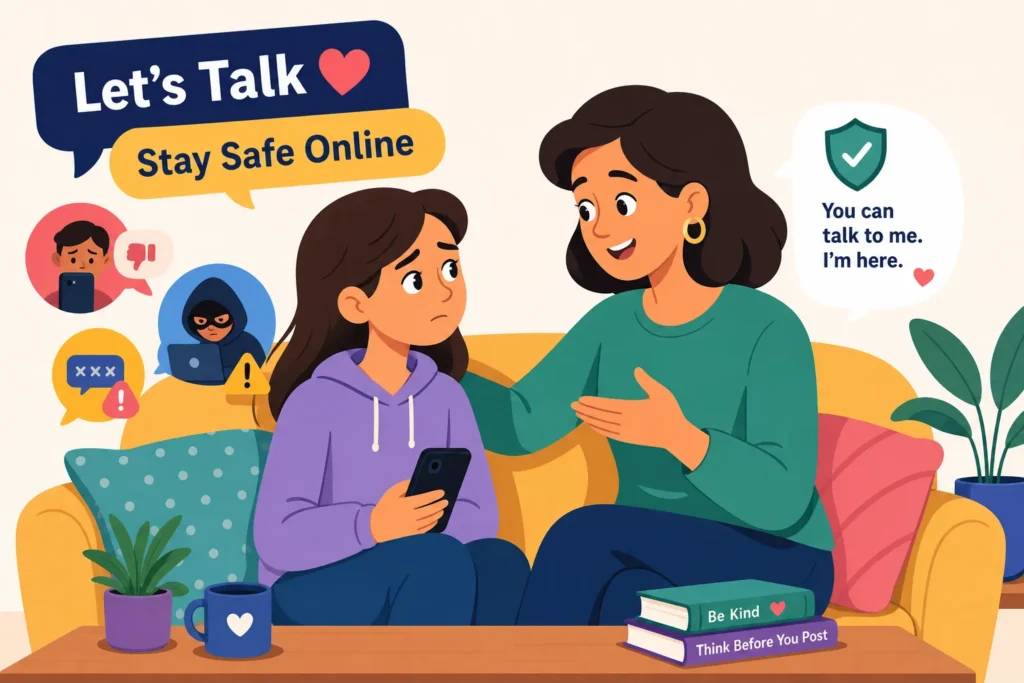
How do I talk to my middle schooler about social media risks? If you’ve ever rehearsed that conversation in your head, picked a calm moment, sat down near your kid, and said, “So, I wanted to talk about social media”, only to get a single slow blink and a mumbled “okay” before the conversation died faster than your phone battery at 3 p.m., you’re not behind. You’re just a normal parent navigating one of the harder conversations of this decade.
Many kids aged 11 to 14 are already active on platforms like TikTok, Snapchat, and Instagram and are especially vulnerable to the harms those platforms can cause. A 2025 UCSF study found that the majority of 11- and 12-year-olds already have accounts on major apps, often by entering a fake birthdate. By the time most parents feel ready to talk, the risks are already in play.
Here’s the good news: you don’t need a perfect script or a degree in digital psychology to talk to your middle schooler about social media risks. By the end of this article, you’ll know when to bring this up, how to set a tone that doesn’t trigger an eye roll, and exactly what to say about the risks that actually matter. Let’s get into it.
Why this conversation feels impossible (and why that’s worth fixing)
A lot of parents put off the social media talk because they’re afraid of sounding out-of-touch, alarmist, or worse, like they’re reading from a school newsletter. That hesitation is understandable. But the delay has real costs. By the time a child is 12, there’s a good chance they’ve already encountered some version of the risks you’re planning to warn them about.
The other thing that trips parents up is timing. Bringing up social media right after you’ve caught your kid on their phone past midnight, or at dinner with siblings around, almost guarantees a shutdown. The most productive conversations tend to happen during low-pressure, side-by-side activities: a car ride, a walk around the block, cooking something together. No direct eye contact reduces performance anxiety on both sides, and a teen who isn’t on the defensive is a teen who might actually listen.
Look for natural openings: a news story about an app, something a classmate mentioned, even a commercial. These moments give you something to respond to rather than something to lecture about, and that difference matters more than most parents realize.
How to talk to your middle schooler about social media risks without the eye rolls
The fastest way to lose a middle schooler is to open with “I need to talk to you about something serious.” That phrase is a trap door. Try leading with a question instead, or something you genuinely saw online that surprised you. Curiosity is disarming. The mindset shift here is from watchdog to collaborator: your goal isn’t to scare them into good behavior, it’s to build the habit of talking to you when something online feels off. Think of it as parenting and digital safety working together rather than in opposition.
One of the most underused tools for these conversations is fiction. When characters in a story face anonymous cruelty, viral embarrassment, or pressure to do something online that feels wrong, it creates just enough emotional distance to make the topic feel discussable rather than threatening. C.S. Pascoal’s illustrated YA mystery Accidental Tribes (Prospera Books, published September 22, 2026) follows eight teens who unravel a web of secrets involving AI misuse, hacked systems, and viral humiliation, the same real-world risks that researchers have documented for this age group. The first few chapters are available free online, which makes reading them together genuinely easy. Once you have shared story language, “remember what happened to Maya when she…” becomes a much warmer entry point than a lecture. Fiction creates the distance that makes difficult topics actually discussable.
The risks worth naming out loud
Anonymous and fake accounts are a particular problem for this age group. When someone posts behind a fake identity, the social stakes drop and cruelty becomes easier. The target has no clear person to confront, and the person posting feels protected. Kids ages 11 to 14 are drawn to anonymous platforms for the same reason: less judgment, more freedom to say what they actually think. But those same features create real openings for harassment, predatory contact, and manipulation. Name this plainly with your teen, not to frighten them, but to help them recognize the dynamic when they see it. This is core digital citizenship for tweens: understanding that anonymity cuts both ways.
The viral content piece is trickier because it doesn’t always look dangerous at first. A video posted as a joke can become school-wide humiliation very quickly, because the algorithm rewards engagement, not judgment. And peer pressure in this context is quieter than most parents expect. It looks like fear of being left out of a group chat, or pressure to post something to prove loyalty to a friend group. These aren’t dramatic moments. They’re small, fast, and easy to miss.
The risks worth putting on the table include cyberbullying and harassment, exposure to harmful content, sleep disruption from infinite scroll and late-night notifications, and oversharing personal information like school name, location, or daily schedule. Research shows that more than three hours of daily social media use is associated with higher rates of depression and anxiety symptoms in adolescents, according to findings referenced in multiple public health reviews. That’s not a scare tactic; it’s a number worth knowing.
Scripts: how do I talk to my middle schooler about social media risks?
Short lines that sound like a person, not a policy document, go much further with middle schoolers. Here are a few conversation starters for middle schoolers worth trying, adapted to your own voice:
- “I’m not trying to get you in trouble. I want to know how to help you if something gets weird online.”
- “I want to talk about what counts as private, and what to do if someone is being cruel. Not a lecture, just a plan.”
- “If someone reaches out that you don’t know in real life, pause before you respond. Show me if anything feels off.”
For specific situations, keep it concrete. On oversharing and posting: “Before you post, ask yourself: would I be okay if my teacher, a stranger, and future-me all saw this?” On anonymous contact: “If a message feels cruel, creepy, or pressured, that’s a signal to stop the conversation, save it, and come to me first.” On what happens when something goes wrong: “You don’t have to handle it alone. Come to me early, even if you think you made a mistake.”
The goal of these conversations isn’t surveillance; it’s building the reflex to loop you in early. Teens are far more likely to bring problems forward when they believe they won’t immediately lose their phone over it. Make that expectation clear from the start.
Privacy settings and a shared family agreement
Online privacy for kids starts with settings you configure together, not silently, while they’re at school. Frame it as something you’re doing this weekend, not something being done to them. For TikTok, keep the account private, turn off “Suggest your account to others,” and use Family Pairing to manage screen time and content filters. For Instagram, set the account to private, restrict direct messages to approved followers only, and enable Hidden Words to filter abusive comments. On Snapchat, turn on Ghost Mode in Snap Map so location stays hidden, set “Contact Me” to Friends only, and disable Quick Add so strangers can’t easily find the account. On YouTube, turn on Restricted Mode and use supervised account settings to limit recommendations.
Settings alone aren’t enough, though. A one-sided list of rules gets ignored; a family agreement that the teen helped shape gets respected, at least more often. Sit down together and write three to five shared commitments around screen time and social media rules: what counts as public versus private information, what happens if something upsetting occurs online, and when phones are off-limits (bedrooms after a certain hour, dinner). This isn’t punishment framed as a document. It’s a plan you’re both agreeing to, which is a very different thing.
Warning signs and how to keep the conversation going
One conversation isn’t enough. The goal is to make checking in feel routine rather than loaded. A brief weekly “anything weird happen online this week?” that becomes a normal part of your rhythm is more valuable than a single deep talk. Low stakes, consistent, no drama.
While you’re building that rhythm, know what to watch for. Emotional changes after phone use, sudden withdrawal from friends or activities, secretive or anxious behavior around devices, dropping grades, and new sleep or eating disruptions are all worth paying attention to. Any single sign might mean nothing. A cluster of changes over two to three weeks is when to take a closer look and, if needed, bring in a school counselor or family therapist who works with adolescents. Signs specific to possible online grooming include new secrecy about who they’re talking to, a rapid shift to a new app or platform, and compulsive checking of messages that seems driven by anxiety rather than interest.
The most important thing here isn’t catching your kid out. It’s staying close enough that they feel the door is open. Teens who know they won’t be immediately punished for bringing a problem forward are the ones who actually bring problems forward.
You’re already ahead of most parents
None of this is comfortable. These conversations involve uncertainty, awkward silences, and the specific exhaustion of parenting a human who communicates primarily in sighs. The fact that you read this far means you’re already taking it seriously, and that matters more than getting it perfect.
When you think about how to talk to your middle schooler about social media risks, remember the steps are more straightforward than they feel: pick a low-pressure moment, lead with curiosity, name the specific risks in plain language, build a shared agreement around rules and safety settings, and check in regularly. Keep the door open even when they don’t walk through it right away.
If starting the conversation still feels hard, start with a story. Accidental Tribes is built for exactly this: eight teens, a mystery full of real digital-age pressures, and characters your middle schooler will recognize. It doesn’t lecture. It immerses. And sometimes the best way into a hard conversation is finding out you were both thinking about the same thing all along. Try one of the scripts above tonight, asking yourself “how do I talk to my middle schooler about social media risks?” is already the right first step.