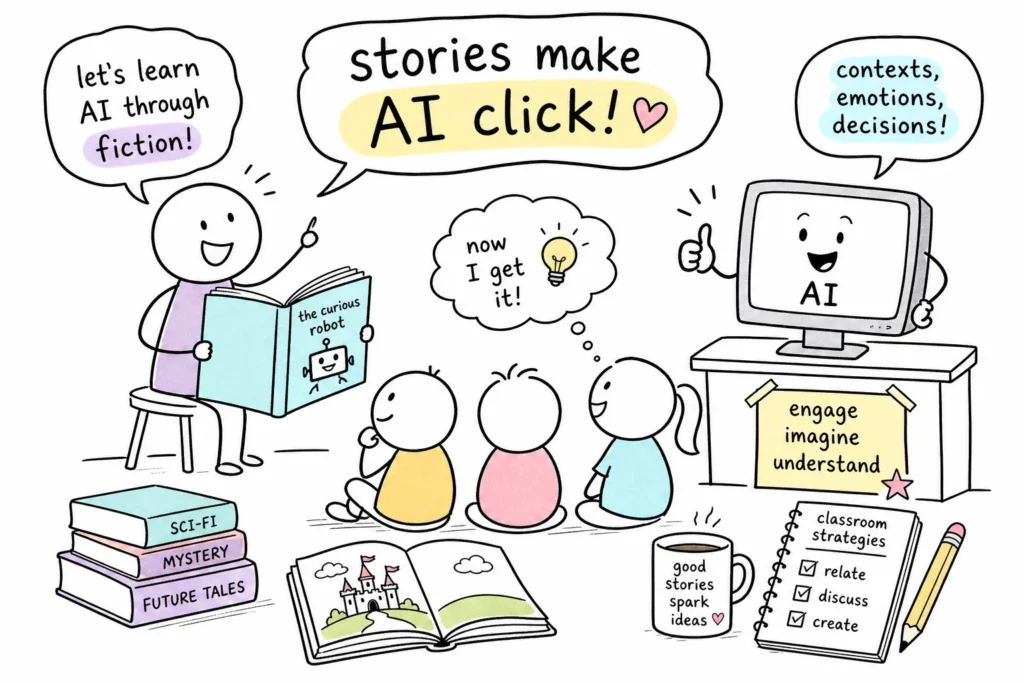
Picture this: a teacher holds up a novel about a teenager whose social media account gets hijacked by an automated system. Within minutes, the class is arguing about consent, surveillance, and who actually holds the power. No slide deck required. That is what fiction does that a textbook cannot: it puts a human face on a technology problem, and that is exactly when students start thinking critically instead of passively consuming information.
So how can teachers use fiction to teach students about artificial intelligence in a way that actually sticks? This guide answers that question with a practical path: selecting the right text for your grade band, running ready-to-use discussion activities, demoing generative AI safely in the classroom, and assessing student reasoning with a rubric that rewards thinking over fluency. Most strategies here are classroom-ready and draw on established ELA frameworks, so you are not starting from scratch.
Why fiction outperforms AI explainers in the classroom
When a student reads about a character whose identity gets publicly destroyed by viral, AI-generated content, they feel the stakes before they understand the mechanics. That emotional entry point is a teaching advantage. Teachers who use narrative texts consistently report that emotional investment lowers the barrier to abstract reasoning: once students care what happens to a character, concepts like bias, privacy, and accountability become concrete rather than theoretical.
Discussion also flows differently from stories than from tech explainers. Open-ended ethical conversation is easier to sustain when every student in the room shares a common, emotionally resonant text as a reference point. This matters especially in mixed-ability English classes, where some students have never written a line of code. Fiction gives everyone something to anchor to, regardless of technical background, which means the AI conversation opens up to everyone in the room, not just the students who already know the terminology.
Choosing the right fiction for your grade band
For middle school students in grades 6 through 8, the strongest entry points are texts that raise big questions without overwhelming young readers. The Wild Robot by Peter Brown, written for ages 8 to 12, opens conversations about belonging and adaptation in accessible, emotionally rich terms, and works best at the start of this range. Isaac Asimov’s “The Fun They Had” is a quick read that generates immediate discussion about technology’s role in daily life, and Ray Bradbury’s “There Will Come Soft Rains” pairs well alongside it for questions about automation and human absence. The AI Incident by J.E. Thomas (2025), a middle-grade novel, works well for questions about trust and what makes someone human. The selection logic here is straightforward: start abstract enough to feel safe, specific enough to anchor a real conversation.
For high school students in grades 9 through 12, the texts can go deeper. AI 2041 by Kai-Fu Lee and Chen Qiufan is unusually classroom-practical because it pairs speculative fiction with explanations of the technologies and ethical issues behind each story, covering data collection, privacy, and bias in ways that support evidence-based argument writing. It was written for adults, so preview it and assign selected stories. Mary Shelley’s Frankenstein holds up remarkably well for creator responsibility discussions. E.M. Forster’s “The Machine Stops” rewards close reading about system dependence and the loss of autonomy, and it connects modern AI debates to older ethical frameworks in ways that satisfy standards-aligned analysis tasks.
One novel that launched this fall sits at the center of this conversation in a way that is worth noting for teachers planning their 2026 units. Accidental Tribes by C.S. Pascoal (Prospera Books, September 22, 2026) follows eight teenagers whose lives intersect through hacked systems, viral humiliation, and institutional deception. Because the story is told through eight distinct characters, students see the consequences of AI misuse from multiple perspectives at once. What sets it apart from many fiction choices is that it was designed with classroom use in mind, including teacher guides and library resources built specifically for AI ethics and digital citizenship discussions. Free first chapters are available to preview before committing to the full text.
How can teachers use fiction to teach students about artificial intelligence: three discussion strategies
The most reliable discussion prompt structure starts with a scene where a character interacts with, or suffers the consequences of, an AI system. From that scene, teachers can extract three or four ethical pressure points using a simple template: identify the technology involved, name who benefits, name who is harmed, and ask whether the character had meaningful choice. This template maps directly onto AI literacy concepts like consent, transparency, and algorithmic bias, and it produces questions that students can actually debate rather than just answer.
Pairing a fictional chapter with a short news article or explainer about a real AI incident that mirrors the story adds another layer. A chapter featuring deepfake-style content pairs naturally with a factual piece on AI-generated harassment in schools. That pairing helps students distinguish narrative from fact, evaluate sources, and connect literature to lived reality. It also checks both ELA reading standards and AI literacy goals at once, which makes it an efficient use of limited class time.
Ethical dilemma exercises are the third strategy, and they work especially well with ensemble-cast novels. Give students a character’s decision point and ask them to argue for one of three possible responses using textual evidence. Build the activity in 20 minutes, run it in class, and you have a strong formative assessment of ethical reasoning. With a multi-perspective novel like Accidental Tribes, where eight characters make different choices in response to the same technological threat, this activity has strong structural support built in: the novel’s design already presents multiple ethical viewpoints within a single storyline.
Running a safe generative AI demo alongside your text
A live demo is often more engaging and interactive than a video because students can suggest prompt edits in real time, which immediately teaches them that AI output is shaped by input, not objective truth. The non-negotiables for a safe classroom demo are straightforward: use a teacher-owned account, confirm school privacy settings are active, enter no student personal information, and keep the demo to one prompt at a time on a shared screen.
Classroom prep matters as much as the demo itself. Pre-test your prompt before class so the demo does not surface inappropriate or confusing output during the lesson. Having a backup prompt ready is also a smart precaution, especially for classes where students are likely to push the activity in unexpected directions.
The character interview activity is one of the most effective fiction-and-AI comparisons you can run. The teacher prompts the AI to respond as a character from the class novel, then projects the output. Students compare the AI’s responses against the actual text: Does it get the character’s values right? What did it invent? What did it flatten or miss? This makes hallucination and bias visible through a frame students already understand. End the activity by having students write one paragraph arguing whether the AI understood the character. That paragraph is also a defensible ELA writing assessment, which means the activity serves two instructional purposes at once.
Aligning fiction-based AI lessons to standards
The three activity types map cleanly to Common Core ELA standards without forcing artificial connections. Discussion prompts and dilemma exercises align to Reading Literature standards for citing textual evidence and analyzing theme (anchor standards CCRA.R.1 and CCRA.R.2, and the matching RL.1 and RL.2 standards at each grade), as well as Speaking and Listening standards for evidence-based collaborative discussion (CCRA.SL.1). Paired reading satisfies both RL and informational text (RI) standards for comparing fictional and nonfiction treatments of a topic. Written responses from the character interview activity and the dilemma exercise hit Writing standards for argument with evidence and reasoning, argument writing with a named claim, supporting evidence from the text, and a closing reflection. AI does not replace the standard-aligned work: it provides a new context for the same ELA thinking skills.
ISTE standards focus less on AI content and more on how students engage with technology as empowered learners, digital citizens, and reflective users. The character interview activity satisfies ISTE expectations around media literacy and the ability to interrogate AI outputs. The paired reading strategy covers responsible tool use and source evaluation. A clean lesson map for both frameworks looks like this:
| Lesson component | Standard anchor | Student task |
|---|---|---|
| Discussion prompts from fictional dilemmas | RL, SL | Cite evidence, analyze theme, discuss collaboratively |
| Paired fiction and nonfiction reading | RL, RI | Compare treatments, evaluate sources |
| Character interview with AI output comparison | W, ISTE | Write evidence-based argument, interrogate AI output |
Assessing what students actually learned about AI
Formative checks matter more here than in most units because students need mid-unit feedback to calibrate their ethical reasoning before a final task asks them to defend a position. Short, criterion-based checklists with four levels (emerging, developing, proficient, advanced) work well for low-stakes tasks like explaining how an AI system works in their own words, flagging possible hallucinations in the character interview activity, or identifying one ethical concern from the day’s reading. Keep formative tasks brief and feedback immediate.
For summative assessment, an analytic rubric with five distinct criteria reliably measures what students actually learned. Those criteria are:
- Conceptual accuracy: can the student explain the AI concept correctly?
- Quality of reasoning: is the argument logical and specific?
- Evidence and source verification: does the student cite text and check AI output?
- Ethical analysis: does the student identify bias, privacy, or fairness issues?
- Reflection on AI use: does the student explain what the tool got right and wrong?
The design principle that matters most: reward reasoning over polished output. A student who produces fluent AI-assisted writing without defending their thinking should score lower than a student with messier prose and sharper critical analysis. That distinction is the whole point of the unit.
How can teachers use fiction to teach students about artificial intelligence: the practical case for starting with one great book
Using fiction to teach AI literacy works because it makes abstract technology stakes personal, and personal stakes produce real thinking. Teachers who start with a well-chosen novel or short story, run one or two of the discussion strategies outlined here, and anchor lessons to existing ELA standards already have a defensible, engaging AI unit, without adding a separate course or technology block to their schedule.
For schools that want a single novel doing most of this lifting from day one, Accidental Tribes by C.S. Pascoal (Prospera Books) is worth a close look this school year. It was built with exactly this kind of classroom conversation in mind, and educator resources are available to help teachers evaluate the fit. If you are asking how can teachers use fiction to teach students about artificial intelligence without overhauling your curriculum, starting with one purposefully designed novel is the most practical answer available right now. For more on why stories work, see Teaching AI ethics to teens: why fiction works best.