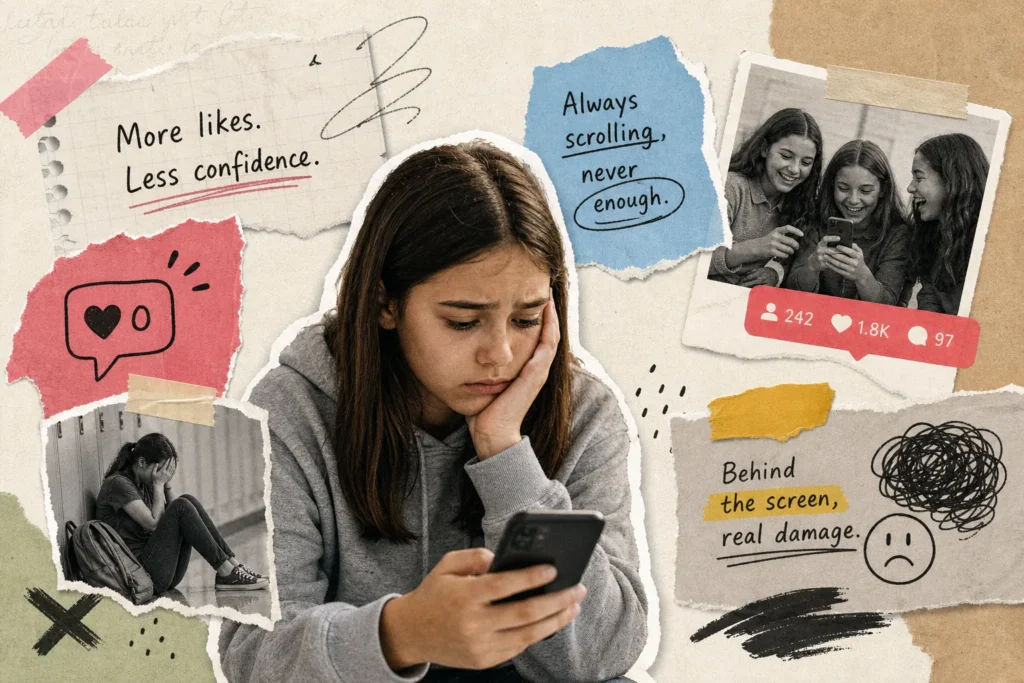
You know that feeling. Your 12-year-old comes to dinner and something is just… off. Their shoulders are tense. They keep glancing at their phone, which is face-down on the table because you made a rule about that. But their mind isn’t at the table with you. It’s somewhere else entirely, and you can’t quite name what you’re worried about. You just know something shifted.
So what are the real dangers of social media for middle schoolers, and how do you know when to worry? That low-grade dread you’re carrying isn’t paranoia. The research backs it up completely. Early adolescence is one of the most neurologically vulnerable windows in a child’s life, and social media platforms were not designed with your 12-year-old’s wellbeing in mind. They were designed to keep them engaged, and those two goals are not the same thing.
This article covers the actual risks, the warning signs that hide inside ordinary “teenager stuff,” and eight practical steps you can start this week. And if direct conversations about phone safety tend to go sideways in your house, there’s something worth knowing at the end: some of the most powerful conversations about these risks happen not through parent lectures but through stories teens genuinely want to read.
Why Middle School Is the Highest-Risk Window for Social Media Dangers
The brain is literally under construction at 12 and 13
Your middle schooler’s prefrontal cortex, the part of the brain responsible for impulse control, long-term thinking, and evaluating consequences, won’t finish developing until their mid-twenties. At the same time, their brain’s reward system is running at peak volume. That combination makes 12- and 13-year-olds uniquely susceptible to exactly the features social media platforms rely on. The American Psychological Association notes that early adolescents are “particularly susceptible to likes and peer feedback” in ways older teens and adults simply are not, and multiple studies show these effects are often stronger in girls at this age.
What the research actually says about depression and anxiety
A large cohort study tracking 11,876 children found that within-person increases in social media use during early adolescence predicted greater depressive symptoms one year later. A separate longitudinal study found that more than three hours per day on social media was linked to roughly double the risk of poor mental health outcomes, including depression symptoms, after controlling for baseline mental health. A 2024 review in a peer-reviewed psychology journal confirmed that problematic social media use is associated with both depressive and anxiety symptoms across multiple studies.
Here’s the nuance worth understanding: the association is real but modest on average. What matters more than total time is how they’re using it. Compulsive checking, emotional dependence on feedback, and public self-presentation predict poor mental health outcomes more reliably than screen time alone. Knowing this actually gives you something concrete to watch for.
The Real Dangers of Social Media for Middle Schoolers: Platform Features Built to Hook Kids
Infinite scroll and the disappearing stopping point
Algorithmic recommendation engines are built to predict and serve the content most likely to keep a user engaged, not the content that’s healthiest for them. For preteens, this can mean a slide from dance videos to extreme diet content in a single session. Infinite scroll removes the natural stopping points that even an adult with full impulse control struggles to impose on themselves. A middle schooler doesn’t have those brakes yet. Research consistently identifies algorithmic feeds combined with likes, notifications, and infinite scroll as the features most strongly associated with compulsive use in preteens.
Likes, notifications, and the dopamine loop nobody explained to your kid
Neuroimaging studies show that social media likes activate the same reward-processing regions of the brain as other social rewards, specifically the ventral striatum and nucleus accumbens. A UCLA study found that adolescents shown photos with many likes displayed increased activity in these reward circuits, similar to responses triggered by money or food rewards. The effect is amplified during adolescence because the reward system is highly responsive while the prefrontal control systems that would normally moderate it are still maturing.
Think about it from your kid’s perspective: they post a photo and then check the like count every four minutes. That’s not a personality flaw. It has a neurological explanation. Notifications compound this through variable reinforcement, meaning unpredictable rewards arriving at irregular intervals, which conditions habitual checking behavior the same way a slot machine does. Knowing this doesn’t make it less frustrating, but it does reframe what you’re actually dealing with.
Cyberbullying, Privacy Risks, and Viral Humiliation: More Dangers of Social Media for Middle Schoolers
The numbers are worse than most parents realize
More than half of U.S. middle and high school students, 58%, report experiencing cyberbullying at some point. Platform-specific data shows roughly one in three Snapchat users and about one in five on Instagram and TikTok have experienced some form of online harassment. Anonymous accounts make this significantly worse by lowering the social cost of cruelty to near zero. There’s no face-to-face accountability. A classmate who would never say something cruel in the hallway will type it without hesitation from behind a username.
What makes cyberbullying categorically different from in-person bullying is that it follows a child home, into their bedroom, and into the two minutes before they fall asleep. There’s no physical refuge. The harassment is always one notification away.
Grooming, privacy risks, and why anonymous platforms are especially dangerous
Beyond peer-to-peer harassment, middle schoolers face real grooming and privacy risks on social platforms. Anonymous or semi-anonymous apps create easy access for adults who misrepresent themselves online. A 2023 report from Thorn, a child-safety nonprofit, found that 1 in 7 minors reported being asked to keep an online relationship secret from their parents, a classic grooming behavior. Many middle schoolers share personal details, school names, or location information without recognizing that a public profile can be seen by anyone. Teaching your child never to share identifying information and to flag unsolicited private messages from strangers is a basic but critical layer of protection.
How AI-generated content has raised the stakes
The more recent threat is significantly more severe. AI tools now make it possible for other students to fabricate realistic fake images of a peer and distribute them instantly through group chats and social apps. This is happening in American middle schools right now. In one Louisiana investigation, AI-generated nude images of eight female middle school students were found circulating among classmates. The content is synthetic but looks real, which means victims have to fight both the emotional harm and the false impression that the material is authentic. Viral humiliation of this kind, designed not just to hurt one person privately but to spread rapidly, can feel irreversible to a 12-year-old, and in any practical sense, it often is.
Warning Signs Your Middle Schooler Is Struggling Online
Behavioral changes that look like “just being a teenager”
Watch for secrecy around the phone, especially pulling it away or turning it over when you walk by. Notice sharp mood changes directly after time on a device, distinct from general moodiness. Withdrawal from in-person friendships or family interaction, particularly after what should have been a normal weekend, is worth paying attention to. Sleep disruption is one of the clearest signals: staying up to monitor responses, waking to check notifications, or resisting charging the phone outside the bedroom at night. Sleep deprivation is one of the primary pathways through which social media use is linked to depressive symptoms in early adolescence, so this one matters more than it might seem.
Social and emotional signals that are easier to miss
Subtler signs include a sudden loss of interest in hobbies they used to love, anxiety about attending school (especially after a weekend or break), and a new preoccupation with appearance or social comparison. Middle schoolers who are being harassed online often don’t tell parents directly, because they fear the phone will be taken away or because the shame feels too large to put into words. Watch for changes, not just specific behaviors, because your kid is unlikely to ask for help directly. That reluctance to bring it up is itself a signal.
Eight Practical Steps to Reduce Harm Right Now
Setting up the right controls without creating a surveillance state
Three built-in tools are worth setting up as a baseline:
- Apple Screen Time with Family Sharing lets you set daily limits per app, downtime schedules, and content restrictions across iPhone and iPad.
- Google Family Link does the same for Android and Chromebook users, with the added option to require your approval before new apps can be installed.
- Microsoft Family Safety covers Windows devices and Xbox with similar daily limits and content filtering.
Safe Search and YouTube Restricted Mode are quick wins on any shared household device and take about three minutes to enable.
Frame these controls as a training scaffold, not a permanent wall. Involve your kid in setting them up where you can. The goal is to set reasonable boundaries now and loosen them gradually as they demonstrate better judgment. Controls work best when they’re paired with conversation, not used as a substitute for it.
The conversations that actually land (and a few scripts to try)
Research on active parental mediation, meaning real, ongoing conversation about what kids are seeing online, consistently shows better outcomes than monitoring alone. The key is framing. Curiosity works better than accusation. Here are three starters that tend not to trigger a shutdown:
- “What’s one thing about social media that feels fun right now, and one thing that feels stressful?” This keeps it balanced and specific rather than overwhelming.
- “What are your friends dealing with online these days?” Using peers as the entry point feels less like a safety lecture and more like genuine interest.
- “I saw this thing about [news story]. What do you actually think about that?” Sharing a relevant story and asking for their opinion treats them as a thinking person, not a problem to be managed.
A family media agreement, drafted together rather than handed down, works better than a mandate. Include phone-free zones, a no-devices-at-bedtime rule, and an open-door policy if something scary happens online. Revisit the agreement every few months as your child matures. A 12-year-old and a 14-year-old are genuinely different people, and the rules should reflect that.
When a Story Reaches Where a Lecture Can’t
Most middle schoolers shut down the moment a conversation starts to feel like a safety lesson. The eye rolls aren’t defiance. They’re a developmental response to being talked at rather than heard. Studies on bibliotherapy and adolescent social-emotional learning suggest that young readers can experience consequences, emotions, and moral complexity through characters they care about, without the defensive wall that goes up in a direct conversation. This is why educators and school counselors consistently use novels as entry points to difficult conversations about identity, belonging, and peer pressure.
Accidental Tribes by C.S. Pascoal (Prospera Books, published September 22, 2026) weaves exactly these issues into a high-stakes mystery following eight distinct teen characters. Themes of AI-generated harassment, anonymous accounts, viral humiliation, social media addiction, and institutional deception run throughout a story that was developed with input from a Teen Advance Reader Council, meaning real middle schoolers shaped what ended up on the page. The book has received endorsements from educators and literary publications including Midwest Book Review and The Children’s Book Review.
The practical move for parents: hand it to your middle schooler, then ask which character they related to most. That one question opens more honest conversation than ten safety lectures. Classroom and library discussion guides are available for teachers and school counselors working on digital citizenship units. Free first chapters are available, so you can read ahead yourself, or read it together.
The Real Dangers of Social Media for Middle Schoolers Are Real, and So Is Your Ability to Reduce Them
Understanding what are the real dangers of social media for middle schoolers is the starting point every parent needs. Those dangers are measurable, documented, and specific. But they’re not inevitable. The research gives you something concrete to work with, the tools exist to reduce exposure, and the conversations, though imperfect, do matter over time.
The goal was never to eliminate social media from your kid’s life. The goal is to help them build the judgment to navigate it. That takes consistent rules, honest conversations, and sometimes a really good story to break the ice. You’re already doing the right thing by learning what’s actually happening in that developing brain and on those platforms. That’s the first step, and it’s not a small one.
Grab the free first chapters of Accidental Tribes and see if it might be the conversation starter your family needs this fall.