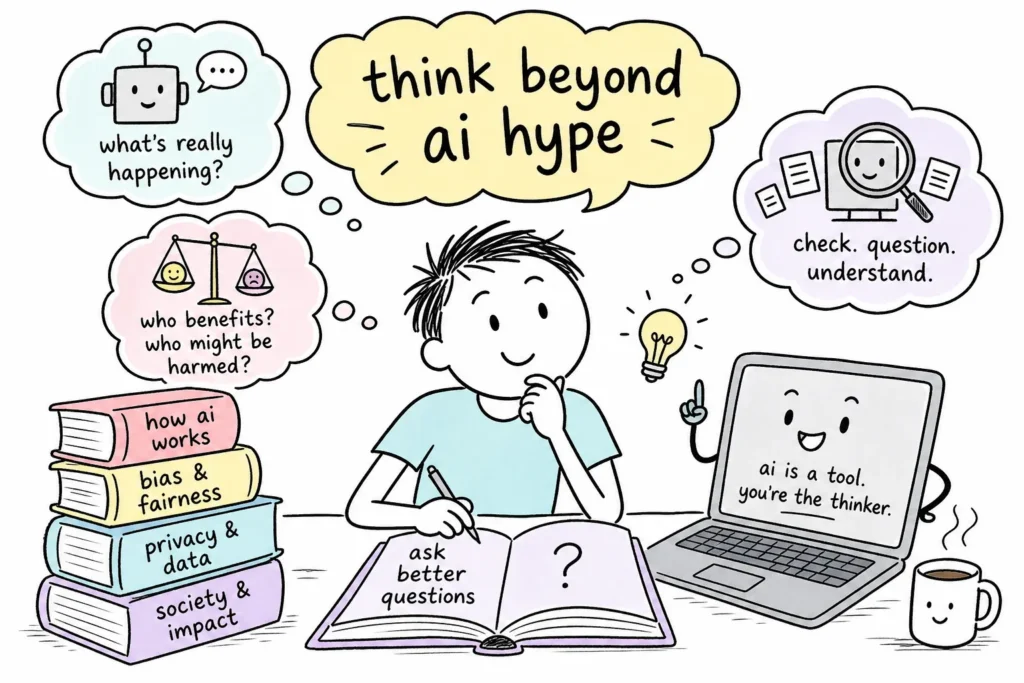
Your students are already inside AI systems. Every recommendation feed, auto-graded essay tool, and content filter they touch is shaped by algorithms they’ve never been asked to question. The problem isn’t that teens don’t care about this. Many teachers report that available materials feel either too simplistic or too technical, pitched somewhere between a lecture for six-year-olds and a policy brief written for a congressional committee. Neither works.
That gap is fixable, and it doesn’t require a new elective or a tech-heavy curriculum overhaul. It requires the right books. If you’re wondering what books help high schoolers think critically about AI, this list is the answer, covering both fiction and nonfiction, ranging from an illustrated YA mystery already earning spots on classroom shelves to a political primer with real analytical depth. It’s a practical starting point for any English, social studies, or ethics class.
Why High Schoolers Need More Than a “Be Careful Online” Conversation
The Gap Between What Teens Experience and What Schools Teach
In 2026, AI-generated content isn’t a hypothetical threat students will face someday. It’s already in their feeds, their college application workflows, and increasingly, their social lives. Most curricula haven’t caught up. When a teen gets auto-scored on a college essay or sees a viral deepfake of a classmate, they need a vocabulary for interrogating what just happened, not a general reminder to “think before you post.”
AI literacy belongs in English class, social studies, and ethics discussions, not just tech electives. The critical questions are fundamentally humanistic ones: who built this system, whose data trained it, and who does it harm. Framing them that way makes them accessible and urgent for almost any classroom context, and it connects to skills students are already developing in their core courses.
What Critical AI Thinking Actually Looks Like for a Ninth Grader
This isn’t about coding. A student who can close-read a biased algorithm the way they close-read an unreliable narrator is already doing AI literacy. The skill set you’re developing includes argument evaluation, recognizing whose perspective is missing, and asking what a “fair” outcome would actually require.
These skills map directly onto what English and social studies teachers already teach, which makes the books on this list much easier to integrate than any standalone AI unit. Pick one. Start a conversation. That’s the whole move.
What Books Help High Schoolers Think Critically About AI: Fiction Picks
Accidental Tribes: The Illustrated Mystery That Earns a Permanent Spot on Your Classroom Shelf
If you teach one book from this list, make it this one. Accidental Tribes by C.S. Pascoal (Prospera Books) is a YA mystery involving hacked systems, viral humiliation, and AI-generated fakes, built around a group of defiant teenagers uncovering institutional lies and buried secrets. It reads fast, the characters are distinct and genuinely funny, and the ethical questions embedded in the mystery are sharp enough to anchor a full Socratic seminar.
What makes it especially classroom-ready is the format. The illustrated, ensemble-cast structure lowers the entry barrier for reluctant readers without dumbing down the content. Classroom discussion guides are available online directly from Prospera Books, which means you can prep a lesson before the class set arrives. The discussion materials cover AI misuse, digital citizenship, identity, belonging, and institutional accountability, ready to use as written or adapted for your context.
Other Fiction Titles That Tackle Deepfakes and Digital Manipulation
AdelAIDE: Just Wants to Help by Melinda Salisbury (2024) is a strong companion read for grades 9–10. The novel features a home-assistant AI whose helpfulness slowly turns harmful, opening a clean discussion on the gap between design intent and real-world impact. After the first few chapters, ask students: if this system did exactly what it was designed to do, why is the outcome still harmful?
Our Sister Again by Sophie Cameron (2022) follows a family that joins a secret trial to bring their late daughter back as a lifelike AI robot. It’s emotionally gripping and surfaces direct questions about grief, consent, and whether an AI copy of a person is still that person. It’s written for younger readers (ages 9 to 11), so in high school it works best as a quick, accessible read for grade 9 or for students who need an easier entry point, and it pairs well with a short reading on data rights.
Every Line of You by Naomi Gibson (2021) handles AI-gone-wrong territory from a different angle: a teen who builds an AI companion that becomes possessive and manipulative. One lesson hook worth using: ask students to identify the exact moment the AI shifted from tool to threat, and what design choices allowed that to happen.
What Books Help High Schoolers Think Critically About AI: Nonfiction Picks
For Students: Accessible Reads That Don’t Require a CS Degree
Artificial Intelligence Ethics and Debates by Tracy Abell is an age-targeted option that introduces major debates, including fairness, bias, and accountability, without requiring any technical background. It works as a classroom set and as an independent read, which gives you flexibility depending on your setup.
For Honors and AP Classes: Titles That Go Deeper
AI Ethics by Mark Coeckelbergh covers algorithmic justice, automation, and moral agency in language strong readers can handle. It works especially well for debate-style discussions: assign a chapter before a class session on AI hiring systems and let students argue from the text. A Citizen’s Guide to Artificial Intelligence adds a political and legal lens that pairs naturally with civics or government classes, giving older students the scaffolding to argue about AI policy rather than just describe it.
The Ethical Algorithm works in enrichment settings where students can handle a more technical argument about designing socially accountable systems. It’s not a casual read, but for the right class, it generates the kind of genuine intellectual friction that good discussion is built on.
Matching Each Book to Your Actual Classroom Goal
If Your Goal Is Bias and Data Literacy
Pair AI Ethics by Coeckelbergh for conceptual grounding with Accidental Tribes for narrative illustration. The novel gives students emotional entry into what algorithmic bias looks like for a real (or vividly fictional) person. The nonfiction gives them the vocabulary to analyze it. In practice, assigning both tends to work better than assigning either alone: students read the fiction to care, then the nonfiction to understand. That sequence matters.
If Your Goal Is Media Evaluation, Deepfakes, and Digital Manipulation
The fiction titles in the previous section handle deepfakes and anonymous account misuse well, especially Accidental Tribes and AdelAIDE. Pair them with a short MIT OpenCourseWare module on AI bias for a one-period combo. The key lesson hook: ask students to find a real news story involving AI-generated media, trace it back to who created it, and explain why. In practice, that one exercise tends to build more transferable skepticism than a lecture on the same topic.
If Your Goal Is Ethics and Policy Discussion
A Citizen’s Guide to Artificial Intelligence gives a strong foundation for a structured Socratic seminar or fishbowl discussion. The free classroom guides for Accidental Tribes cover institutional accountability and AI misuse in ways that bridge personal narrative and systemic analysis, useful as a connector between story-driven reading and the more analytical nonfiction on your shelf.
How to Turn Any of These Books Into a Real Classroom Discussion
Free Resources That Pair With These Reads for a Single Class Period
Most nonfiction titles don’t come with built-in teacher kits, but open educational resources fill the gap. OER Commons and MIT OpenCourseWare’s Ethics of AI Bias module both work as one-period companions. The MIT Ethics of AI Bias video is explicitly recommended for classroom use and pairs cleanly with a short book excerpt and a discussion prompt, one of the most practical no-prep additions to any AI ethics lesson.
Accidental Tribes is the clear exception among the fiction titles. Free classroom discussion guides are available online from Prospera Books, covering AI misuse, identity, and institutional accountability. For a teacher building a unit from scratch, having ready-to-use materials before the book even arrives is a genuine time-saver.
Three Discussion Hooks That Work Across the Entire List
These three questions are drop-in prompts that work whether your class just read a mystery chapter or a policy excerpt. Use them as written or adapt them to whatever text is on the table that day.
- Whose perspective is missing from this AI system?
- What would have to be true for this technology to be fair?
- If you were designing this system, what would you change first?
All three questions develop the same core habit: questioning the system rather than just accepting its output. They’re open enough to generate real disagreement, which is exactly what you want in a classroom where students are learning to think about AI rather than just use it.
Start With One Book, One Question
Don’t wait for a perfect AI ethics unit to appear on your curriculum calendar. Start with one book, one discussion hook, and one question that doesn’t have an easy answer. Every title on this list, from the illustrated mystery of Accidental Tribes to A Citizen’s Guide to Artificial Intelligence, does the same fundamental thing: it gives high schoolers a reason to question the systems already shaping their lives.
If you want the lowest-friction starting point available, check out the free classroom guides for Accidental Tribes from Prospera Books. They’re ready to use before the full book arrives, and the illustrated format with its ensemble cast makes the story genuinely hard to put down, not something you can say about most classroom reads on this topic.
For parents, any of these reads work as a dinner-table conversation starter, especially the fiction titles, where the story pulls a teen in before the harder questions surface. Now that you know what books help high schoolers think critically about AI, the next step is simple: pick one and start the conversation this week. That habit starts with the right book in the right hands, and right now, getting there is simpler than it sounds.